
War Requiem
Gulbenkian Choir and Orchestra
Event Slider

Date
- 20:00 / Cancelled 20:00 / Sold out Thursday, 20:00
- 19:00 / Cancelled 19:00 / Sold out Friday, 19:00
Location
Grand Auditorium Calouste Gulbenkian FoundationPricing
- 28,00 € – 56,00 €
25% – Under 30
10% – Over 65
Cartão Gulbenkian:
50% – Under 30
20% – Over 65
10% – 30 to 65
- Conductor
- Sally Matthews Soprano
- Andrew Staples Tenor
- Florian Boesch Baritone
-
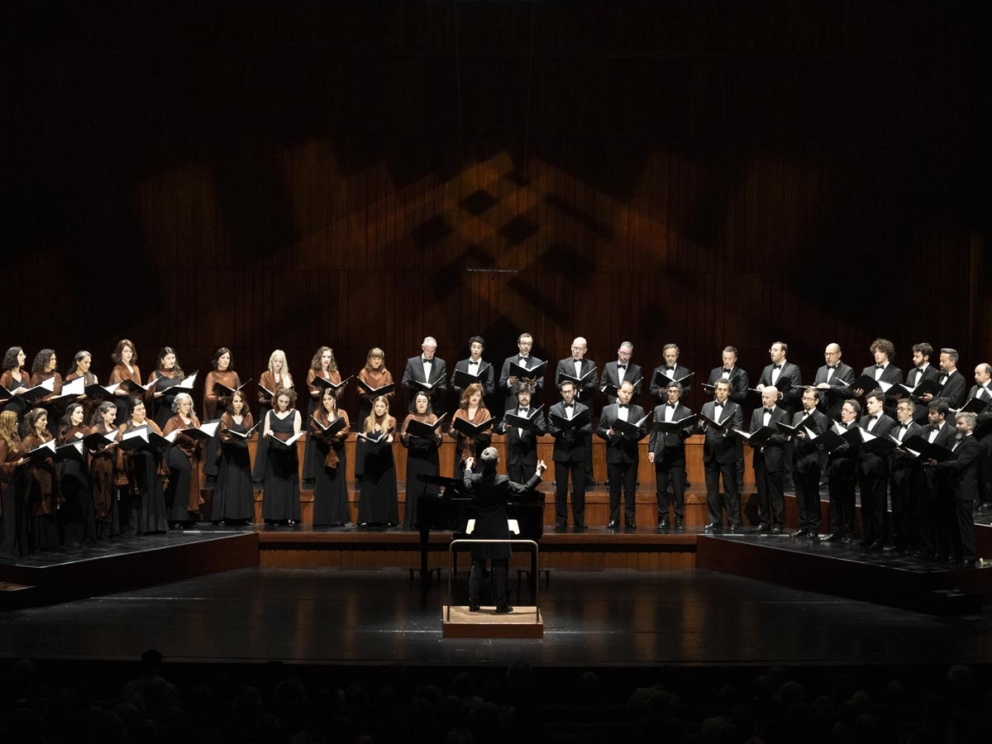
Gulbenkian Choir
The Gulbenkian Choir was founded in 1964 by the Calouste Gulbenkian Foundation as a full symphonic body of around 100 singers. The choir joins the Orquestra Gulbenkian and other orchestras to perform Classical, Romantic and Contemporary choral-symphonic repertoire, but can also perform a cappella. It has performed – and often premiered – many 20th century works by Portuguese and international composers.
The Gulbenkian Choir has been invited to collaborate with major international orchestras, under the direction of conductors such as Claudio Abbado, Colin Davis, John Nelson, Emmanuel Krivine, Esa-Pekka Salonen, Frans Brüggen, Franz Welser-Möst, Gerd Albrecht, Michael Gielen, Michael Tilson Thomas, Rafael Frübeck de Burgos, René Jacobs and Leonard Slatkin, among others.
Besides its regular season of concerts in Lisbon and frequent national tours, the Gulbenkian Choir has repeatedly toured Argentina, Belgium, Brazil, Canada, Denmark, France, Germany, Hungary, India, Iraq, Israel, Italy, Japan, Macao, Malta, Monaco, Netherlands, Spain, the United Kingdom, the United States of America and Uruguay.
The Gulbenkian Choir has recorded extensively for Philips, Deutsche Grammophon, Erato, Cascavelle, Musifrance, as well as FNAC-Music, performing a wide range of repertoire, from Early-Renaissance polyphony to Xenakis. Several of these albums received international awards.
Martina Batič is the current Principal Conductor, succeeding Michel Corboz (1969–2019), Inês Tavares Lopes the Associate Conductor and Jorge Matta the artistic consultant.
-
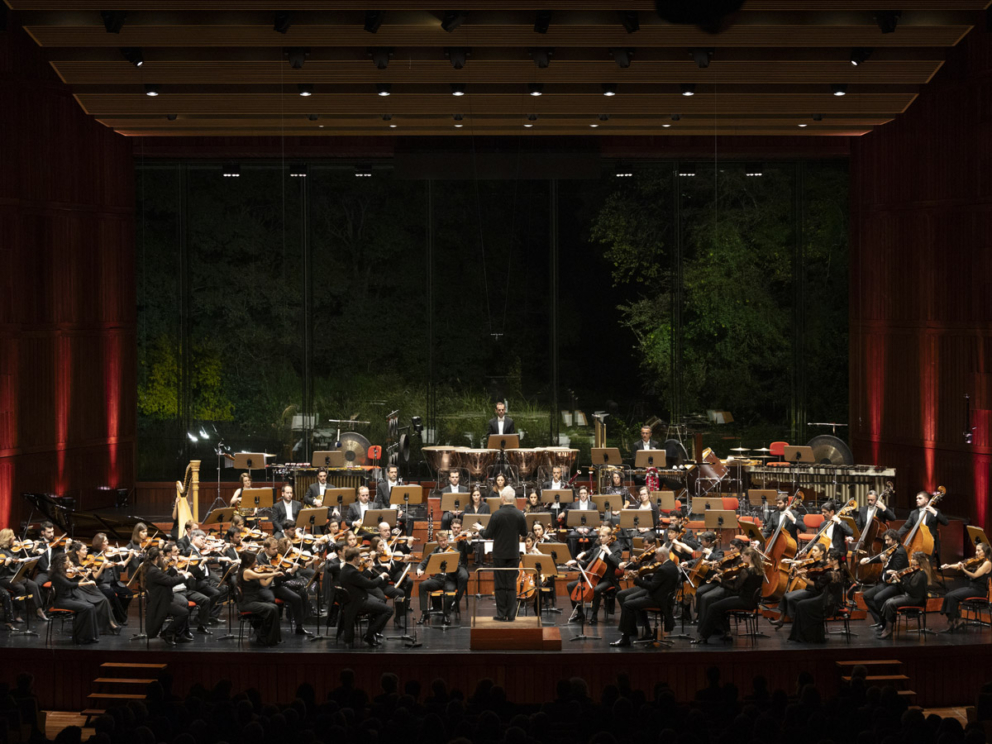
Gulbenkian Orchestra
In 1962, the Calouste Gulbenkian Foundation decided to establish a permanent orchestral ensemble. Originally with only twelve musicians (strings and continuo) it was named “Orquestra de Câmara Gulbenkian”. This collective was successively enlarged and today the “Orquestra Gulbenkian” (the name it has adopted since 1971) has a permanent body of sixty instrumentalists, a number that can be expanded depending on the repertoire.
This structure allows the Gulbenkian Orchestra to interpret works from the Baroque and Classical periods, a significant part of 19th century orchestral literature and much of the music of the 20th century, including works belonging to the current repertoire of the traditional symphonic orchestras. In each season, the orchestra performs on a regular series of concerts at the Gulbenkian Grand Auditorium in Lisbon, where it has had the opportunity of working together with some of leading names of the world of music (conductors and soloists). It has also performed on numerous locations all over Portugal, in an effort to decentralize music and culture.
The orchestra has been constantly expanding its activities in the international level, performing in Europe, Asia Africa, and the Americas. In the recording field, Orquestra Gulbenkian is associated to labels as Philips, Deutsche Grammophon, Hyperion, Teldec, Erato, Adès, Nimbus, Lyrinx, Naïve and Pentatone, among others, and this activity was recognized with several international prizes.
Hannu Lintu is the Music Director of the Gulbenkian Orchestra since 2023.
-
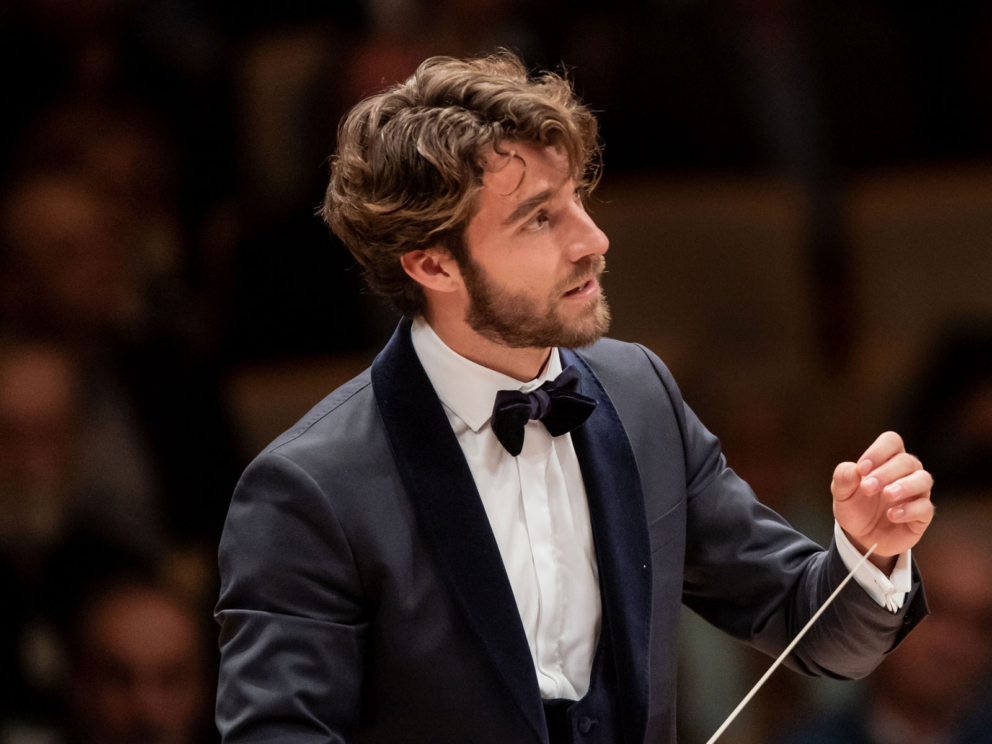
Lorenzo Viotti
Conductor
Lorenzo Viotti has established himself as one of the most compelling conductors of his generation, acclaimed for his charismatic presence, emotional depth, and remarkable versatility across both symphonic and operatic repertoire.
The 2025/26 season sees him on major stages around the world, including performances with the Vienna Philharmonic, Wiener Symphoniker, Orchestre National de France, Orchestra dell’Accademia Nazionale di Santa Cecilia in Rome, and the Filarmonica della Scala, with whom he continues a fruitful collaboration. He also appears with the Gulbenkian Orchestra in Lisbon and the Netherlands Philharmonic Orchestra, where he served as Chief Conductor until 2025. In Asia, he returns to Japan with the Tokyo Symphony Orchestra ahead of becoming its Music Director in the 2026/27 season.
A passionate opera conductor, Viotti debuts at the Palau de les Arts in Valencia with Faust, and returns to Zurich Opera for Die Fledermaus and to the Vienna State Opera for Puccini’s Il Trittico. His tenure as Chief Conductor of Dutch National Opera (2021–2025) featured critically acclaimed productions such as Peter Grimes, the Amsterdam premiere of Die Fledermaus and a three years Puccini cycle in collaboration with director Barrie Kosky.
He has previously led productions at Teatro alla Scala, the Paris Opera, Zurich Opera, and the Semperoper Dresden, while his symphonic collaborations include engagements with the Berlin Philharmonic, Staatskapelle Berlin, Royal Concertgebouw Orchestra, Munich Philharmonic, Gewandhausorchester Leipzig, Cleveland Orchestra, and many others.
Born in Lausanne into a Franco-Italian family of musicians, Viotti studied piano, singing, and percussion in Lyon before continuing his conducting studies in Vienna and Weimar. He rose to international prominence after winning several major competitions, including the Nestlé Young Conductors Award at the Salzburg Festival, the MDR Symphony Orchestra Conducting Competition, and the Cadaqués International Conducting Competition. In 2017, he was named “Newcomer of the Year” at the International Opera Awards.
Benjamin Britten
This concert will have the participation of young musicians from the Gulbenkian Orchestra Course.
A committed pacifist, the English composer Benjamin Britten received a commission to create a work celebrating the opening of the new Coventry Cathedral in 1962, built on the site of the cathedral destroyed by German bombs during the Second World War. Britten then composed a masterpiece entitled War Requiem, combining elements of the Catholic liturgy with nine poems written by Wilfred Owen in 1917 and 1918, in the trenches and in hospital during the First World War. To this day, War Requiem remains one of the most beautiful works inspired by the ideal of peace.
Sponsor Gulbenkian Music

Sponsor Gulbenkian Orchestral Course

The Calouste Gulbenkian Foundation reserves the right to collect and keep records of images, sounds and voice for the diffusion and preservation of the memory of its cultural and artistic activity. For further information, please contact us through the Information Request form.