
Oedipus Rex
Gulbenkian Orchestra and Choir
Event Slider

Date
- 20:00 / Cancelled 20:00 / Sold out Thursday, 20:00
- 19:00 / Cancelled 19:00 / Sold out Friday, 19:00
Location
Grand Auditorium Calouste Gulbenkian FoundationPricing
25% – Under 30
10% – Over 65
Cartão Gulbenkian:
50% – Under 30
20% – Over 65
10% – 30 to 64
- Conductor
- Soprano
- Mezzo-Soprano
- Tenor
- Bass-Baritone
- Bass
- Francisco Cortes Tenor
- Luís Mayer-Bento Baritone
- João Reis Narrator
-
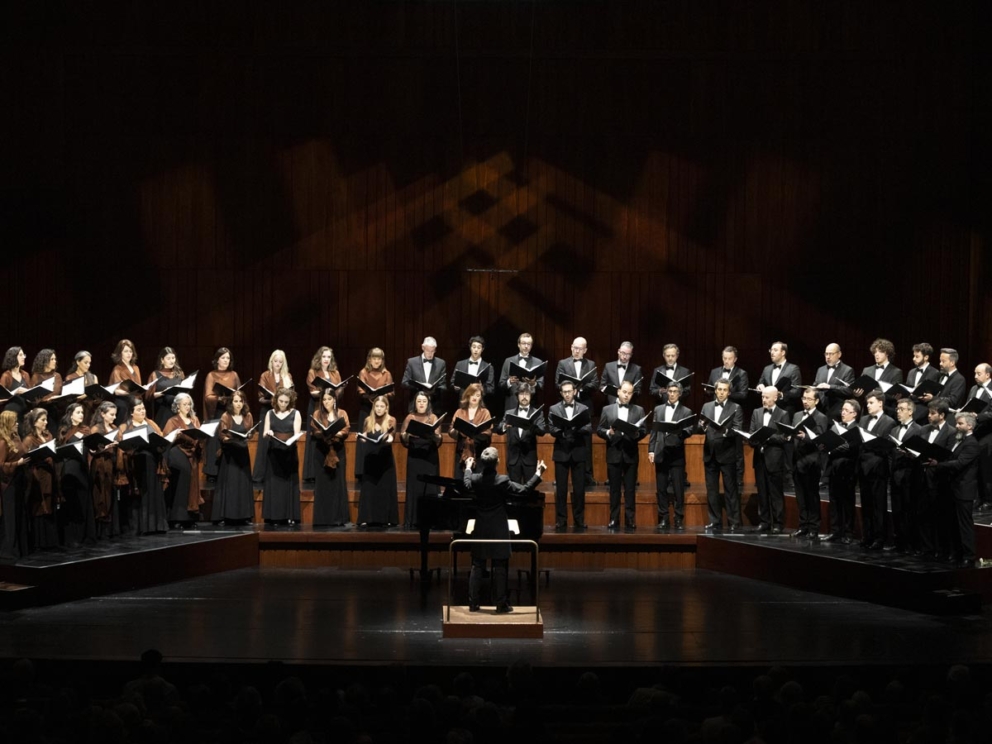
Gulbenkian Choir
The Gulbenkian Choir was founded in 1964 by the Calouste Gulbenkian Foundation as a full symphonic body of around 100 singers. The choir joins the Orquestra Gulbenkian and other orchestras to perform Classical, Romantic and Contemporary choral-symphonic repertoire, but can also perform a cappella. It has performed – and often premiered – many 20th century works by Portuguese and international composers.
The Gulbenkian Choir has been invited to collaborate with major international orchestras, under the direction of conductors such as Claudio Abbado, Colin Davis, John Nelson, Emmanuel Krivine, Esa-Pekka Salonen, Frans Brüggen, Franz Welser-Möst, Gerd Albrecht, Michael Gielen, Michael Tilson Thomas, Rafael Frübeck de Burgos, René Jacobs and Leonard Slatkin, among others.
Besides its regular season of concerts in Lisbon and frequent national tours, the Gulbenkian Choir has repeatedly toured Argentina, Belgium, Brazil, Canada, Denmark, France, Germany, Hungary, India, Iraq, Israel, Italy, Japan, Macao, Malta, Monaco, Netherlands, Spain, the United Kingdom, the United States of America and Uruguay.
The Gulbenkian Choir has recorded extensively for Philips, Deutsche Grammophon, Erato, Cascavelle, Musifrance, as well as FNAC-Music, performing a wide range of repertoire, from Early-Renaissance polyphony to Xenakis. Several of these albums received international awards.
Martina Batič is the current Principal Conductor, succeeding Michel Corboz (1969–2019), Inês Tavares Lopes the Associate Conductor and Jorge Matta the artistic consultant.
-
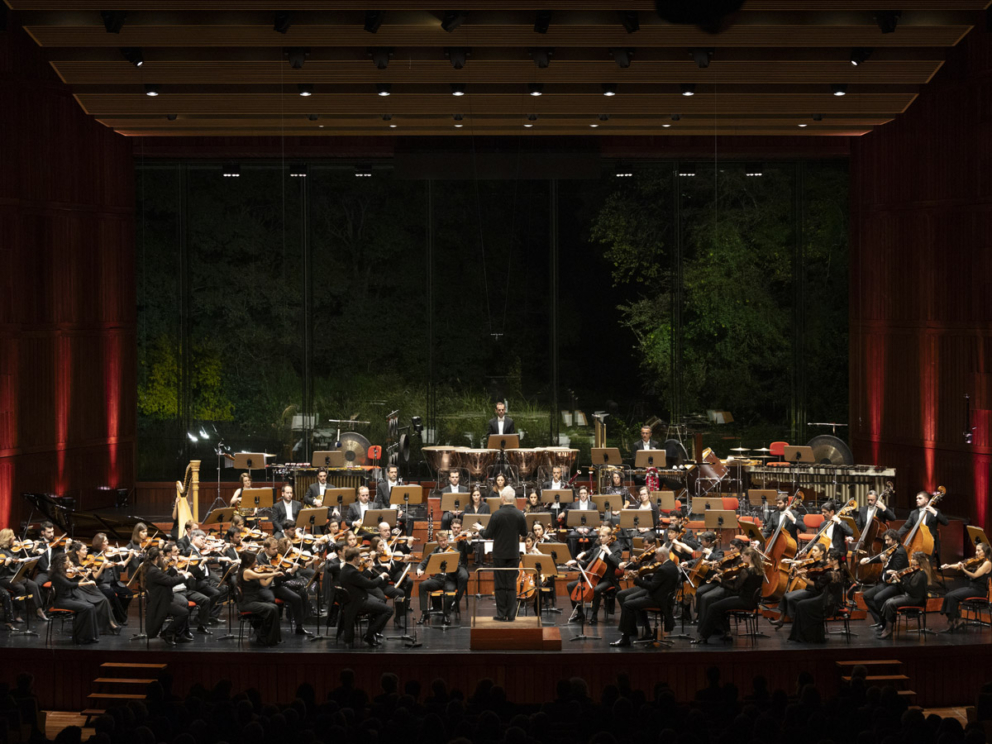
Gulbenkian Orchestra
In 1962, the Calouste Gulbenkian Foundation decided to establish a permanent orchestral ensemble. Originally with only twelve musicians (strings and continuo) it was named “Orquestra de Câmara Gulbenkian”. This collective was successively enlarged and today the “Orquestra Gulbenkian” (the name it has adopted since 1971) has a permanent body of sixty instrumentalists, a number that can be expanded depending on the repertoire.
This structure allows the Gulbenkian Orchestra to interpret works from the Baroque and Classical periods, a significant part of 19th century orchestral literature and much of the music of the 20th century, including works belonging to the current repertoire of the traditional symphonic orchestras. In each season, the orchestra performs on a regular series of concerts at the Gulbenkian Grand Auditorium in Lisbon, where it has had the opportunity of working together with some of leading names of the world of music (conductors and soloists). It has also performed on numerous locations all over Portugal, in an effort to decentralize music and culture.
The orchestra has been constantly expanding its activities in the international level, performing in Europe, Asia Africa, and the Americas. In the recording field, Orquestra Gulbenkian is associated to labels as Philips, Deutsche Grammophon, Hyperion, Teldec, Erato, Adès, Nimbus, Lyrinx, Naïve and Pentatone, among others, and this activity was recognized with several international prizes.
Hannu Lintu is the Music Director of the Gulbenkian Orchestra since 2023.
-
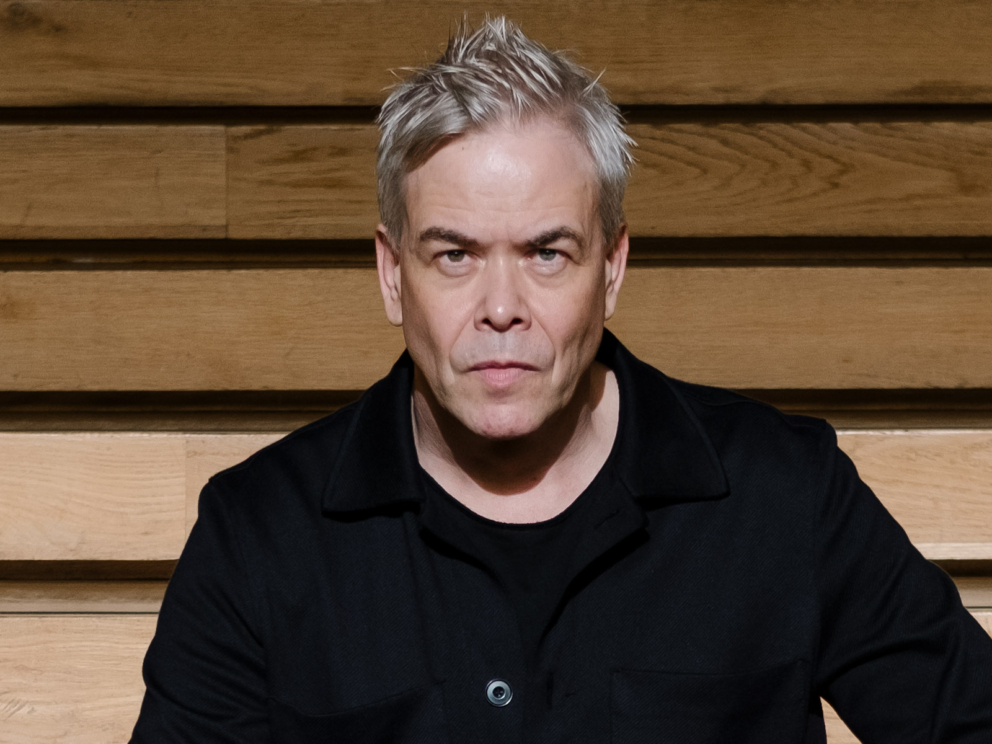
Hannu Lintu
Music Director
“Dynamic and sharp on the podium” (Bachtrack) and with an “extreme clarity of purpose, every detail worth noting” (Los Angeles Times), Hannu Lintu maintains his reputation as one of the world’s finest conductors.
The 2026/27 season marked Lintu’s inaugural year as Music Director of Singapore Symphony Orchestra. He leads the orchestra in varied programmes across the season, including Mahler, Mozart, Scriabin, Tchaikovsky, Auerbach, Adams and Sibelius. He also conducts the orchestra on tour in China. As well as stepping into this new position, Lintu continues his tenure as Principal Conductor of Orquestra Gulbenkian, Artistic Partner of the Lahti Symphony Orchestra, and Artistic Director of the International Sibelius Festival.
In addition to his titled positions, Lintu returns to the Finnish Radio Symphony Orchestra, the Minnesota Orchestra, Netherlands Philharmonic, Hong Kong Philharmonic, and makes his debuts with the Tonhalle Orchester Zürich and the Orchestre National du Capitole de Toulouse.
Symphonic highlights of recent years have seen Lintu conduct the Chicago Symphony, New York Philharmonic (including an immediate re-invitation from the orchestra to perform at Bravo! Vail Festival), Berliner Philharmoniker, The Cleveland Orchestra, Bavarian Radio Symphony Orchestra, Orchestre National de Radio France, Boston Symphony Orchestra, Swedish Radio Symphony Orchestra, BBC Symphony, Deutsches Symphonie-Orchester Berlin, Radio Filharmonisch Orkest, London Philharmonic, Atlanta Symphony Orchestra, Konzerthausorchester Berlin, St Louis Symphony, Baltimore Symphony Orchestra and Orchestre Symphonique de Montréal.
Chief Conductor of the Finnish National Opera and Ballet from 2022 until the end of the 2025/26 season, Lintu is an expert in both operatic as well as symphonic repertoire, Lintu’s recent opera highlights have included Enescu’s Œdipe with the Vienna Symphony at Bregenz Festspiele, Wagner’s Der fliegende Holländer at Opera de Paris and Debussy’s Pelléas et Mélisande at Bayerische Staatsoper as a guest conductor, as well as multiple productions at Finnish National Opera and Ballet, including a recent multi-season Ring Cycle, Poulenc’s Dialogues des Carmélites, Mozart’s Don Giovanni, a choregraphed reimagining of Verdi’s Messa da Requiem, Puccini’s Turandot, Richard Strauss’ Salome, and Britten’s Billy Budd.
Lintu has made several recordings for Ondine, BIS Records, Naxos, Avie Records and Hyperion Records. His diverse discography comprises recordings of Magnus Lindberg’s orchestral works, the complete Beethoven Piano Concertos with Stephen Hough, and Lutoslawski’s Symphonies Nos. 1-4, all with Finnish Radio Symphony Orchestra. His often-gilded work boasts two International Classical Music Awards and several nominations for Gramophone and GRAMMY awards in recognition of recording projects such as Bartók’s Violin Concertos with Christian Tetzlaff, works by Sibelius featuring Anne Sofie von Otter, Rautavaara’s Kaivos, and the Violin Concertos of Sibelius and Thomas Adès with Augustin Hadelich and Royal Liverpool Philharmonic Orchestra.
Lintu studied cello and piano at the Sibelius Academy, where he also later studied conducting with Jorma Panula. He participated in masterclasses with Myung-Whun Chung at L’Accademia Musicale Chigiana in Siena, Italy, and took first prize at the Nordic Conducting Competition in Bergen in 1994.
-
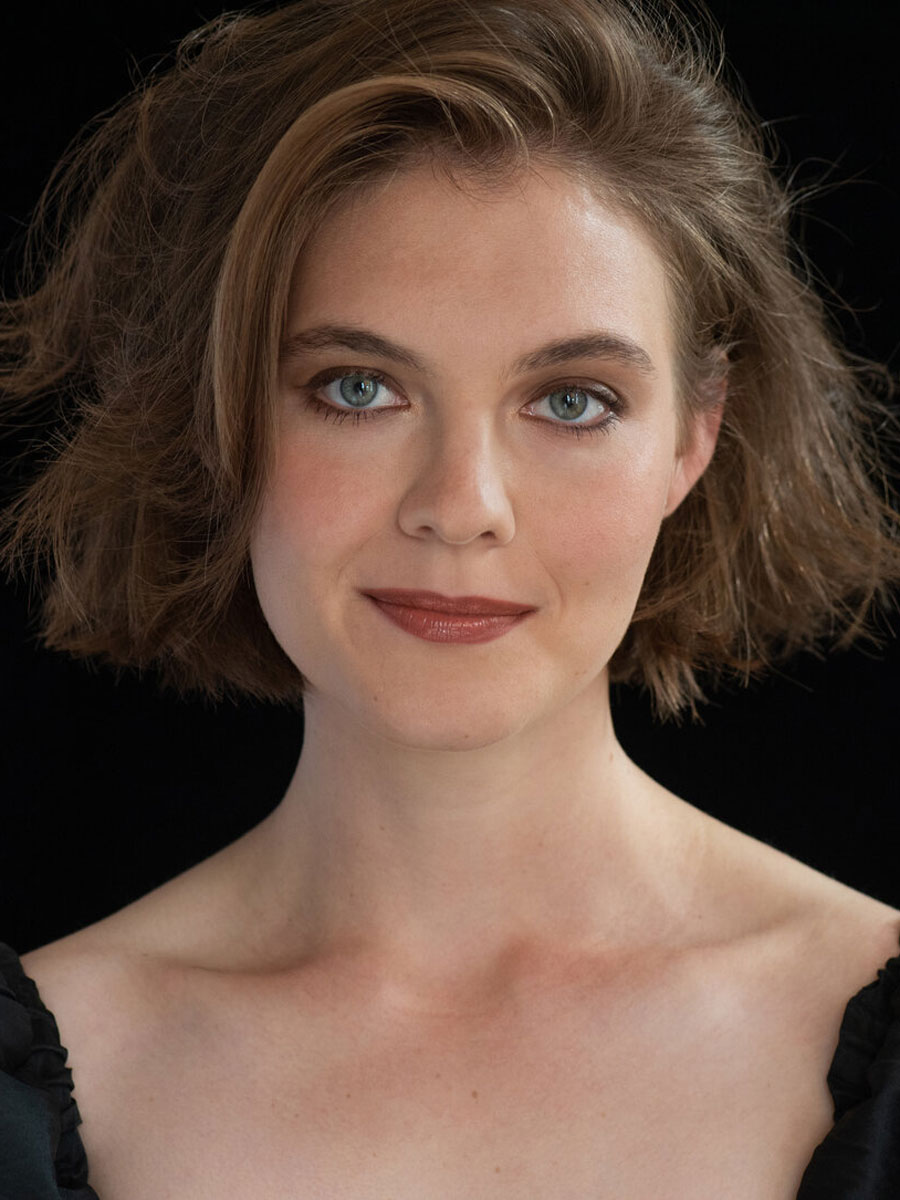
Erika Baikoff
Soprano
Praised for her “seraphically poignant” artistry (Bachtrack) and “bright and buoyant” singing (Houston Chronicle), soprano Erika Baikoff is quickly emerging as one of the most compelling lyric voices of her generation.
In the 2025/26 season, she returns as a member of the ensemble at the Bayerische Staatsoper, making a series of role debuts: Pamina (Die Zauberflöte), Clorinda (La Cenerentola), Najade (Ariadne auf Naxos), Frasquita (Carmen), and Esmeralda (The Bartered Bride). In Munich, she will revisit her acclaimed Zerlina (Don Giovanni) and Gretel (Hänsel und Gretel), a role she also brings to Ópera de Oviedo. Further afield, she joins La Cetra Barockorchester Basel as Ginevra (Ariodante) with performances at the Theater an der Wien, Théâtre des Champs-Elysées, Teatro Real Madrid, Stadtcasino Basel, and others.
On the concert stage, Erika appears with the Bavarian Radio Symphony Orchestra for Mozart’s Requiem under Natalie Stutzmann, BBC Symphony Orchestra for Ravel’s Shéhérazade, Mahler’s Fourth Symphony with the Bremer Philharmoniker, Pergolesi’s Stabat Mater with La Sfera Armoniosa at Amsterdam’s Concertgebouw, and Brahms’s Ein deutsches Requiem with the Orquesta Sinfónica de Navarra Pamplona.
A passionate recitalist, she returns to Schubertiade Schwarzenberg with Daniel Heide, the Chamber Music Society of Lincoln Center for an evening of Parisian Delights, and to both the Heidelberg Festival and Schubertíada with Roman Borisov. Erika also looks forward to debuts at the Wiener Konzerthaus and Highgate International Chamber Music Festival.
Highlights of recent seasons include house and role debuts at Theater an der Wien (Ofelia, Ambleto), Houston Grand Opera (Zerlina, Don Giovanni), Palm Beach Opera (Four Heroines, Les contes d’Hoffmann), Rotterdam Philharmonic Orchestra (Das Rheingold), London Symphony Orchestra (Jenufa), Atlanta Symphony (Mozart’s Great Mass in C) and SWR Stuttgart (Bruckner’s Mass No.3).
Erika is an alumna of the Metropolitan Opera’s Lindemann Young Artist Program, Opéra National de Lyon Studio, Verbier Festival Atelier Lyrique, and Festival d’Aix-en-Provence Académie, she is also a first prize winner of the Helmut Deutsch Liedwettbewerb and the Concours international de chant-piano Nadia et Lili Boulanger. From the 2025/26 season, Erika is a BBC New Generation Artist.
-

Victoria Karkacheva
Mezzo-Soprano
"Victoria Karkacheva’s Charlotte … embodied this same élan. Endowed with a majestic,wide‑ranging vocal range, the Russian mezzo portrayed Charlotte as strong andimpetuous." - Première Loge "Beautiful timbre, with full centres and well‑timed treble rise." - OperaClick
In the 2026/2027 season, Victoria Karkacheva makes her debut as Néris Médée at the Metropolitan Opera, preceded by her performance of Dorabella Così fan tutte at Salzburger Festspiele. Other engagements include Sonyetka Lady Macbeth of Mtsensk for Opéra national de Paris, Hanna May Night for Opéra national de Lyon, the return to Bayerische Staatsoper as Polina The Queen of Spades, and Jocasta in Stravinsky’s Oedipus Rex with Orquestra Gulbenkian in Lisbon.
Season 25/26 saw Karkacheva’s debuts as Carmen at both the Wiener Staatsoper and the Opéra national de Paris, affirming her place among the most compelling mezzos of her generation. Other highlights included Venus Tannhäuser at the Grand Théâtre de Genève, Nicklausse Les Contes d’Hoffmann at Opéra national de Lyon, Marguerite La Damnation de Faust at Théâtre des Champs-Élysées, Charlotte Werther at the Canadian Opera Company, Carmen at Maifestspiele Staatstheater Wiesbaden, Maddalena Rigoletto at Philharmonie de Paris with Le Cercle de L’Harmonie orchestra, and Judith Bluebeard’s Castle in concert with the Gürzenich Orchestra in Cologne.
Previous highlights include Charlotte Werther at Teatro alla Scala, Olga Eugene Onegin and Judith Bluebeard’s Castle at Gran Teatre del Liceu and Teatro Real Madrid, the latter also at Opéra National de Lyon, along with a series of acclaimed roles at the BayerischeStaatsoper, including her recent role debut as Pénélope in Fauré’s Pénélope , Polina The Queen of Spades and Hélène War and Peace .
On the concert stage, she has appeared with the Berliner Philharmoniker under Kirill Petrenko in Iolanta , and Mahler’s Symphony No. 3 with the Helsinki Philharmonic.
Victoria Karkacheva is the recipient of First Prize and the Birgit Nilsson Prize at Operalia2021, and First Prize at the Tenor Viñas Competition 2020.
-

Russell Thomas
Tenor
American tenor Russell Thomas has made his name as one of the most commanding dramatic tenors of his generation. With a voice of remarkable power and expressive range, he has become a defining interpreter of both the Italian lyric and German dramatic repertoire and his ability to move seamlessly between these two demanding traditions is a testament to his technical mastery, stylistic versatility, and dramatic intelligence.
As part of Russell Thomas’ 2026/2027 season, he returns to Royal Ballet & Opera, Covent Garden as Don José in Carmen, conducted by Sesto Quatrini, and to Lyric Opera of Chicago as Bacchus in Ariadne auf Naxos under Oksana Lyniv. On the concert platform, he joins Orquestra Gulbenkian and Hannu Lintu in Stravinsky, Oedipus Rex, the Metropolitan Opera Orchestra under Yannick Nézet-Séguin in Mahler, Symphony No.8 at Carnegie Hall and returns to John Adams' The Gospel According to the Other Mary with the London Symphony Orchestra and Sir Simon Rattle, at London’s Barbican Hall and on European tour.
Recent seasons have seen Thomas significantly expand his experience of the German Helden repertoire with the addition of several major new roles including Kaiser in Die Frau ohne Schatten at the Metropolitan Opera under Yannick Nézet-Séguin, the title role in Tannhäuser at Houston Grand Opera under Erik Nielsen, and Parsifal at Wiener Festwochen under Yi-Chen Lin. Already celebrated for his lyric roles, Thomas has appeared as Canio in I Pagliacci at Lyric Opera of Chicago, Don José at Opéra national de Paris, Cavaradossi in Tosca at Royal Ballet & Opera, and as Werther for Canadian Opera Company.
A graduate of the Metropolitan Opera’s Lindemann Program, Thomas’ many roles on that stage including Don Carlo, Rodolfo (La Bohème), and Ismaele (Nabucco), and he joined the Met Orchestra and Yannick Nézet-Séguin as Otello on their recent European tour. Also enjoying a long-standing relationship with LA Opera - where he served as the company’s inaugural Artist in Residence, mentored the young artist programme and curated their After Hours recital series - he has appeared there as Otello, Radamès (Aida) and Calaf (Turandot), and sang the world premiere of Fire and Blue Sky by Joel Thompson.
As a concert singer, Russell Thomas has appeared with Wiener Philharmoniker, Accademia Nazionale di Santa Cecilia, New York Philharmonic, BBC Symphony Orchestra and Frankfurt Radio Symphony Orchestra in repertoire ranging from Mahler, Das Lied von der Erde and Stravinsky, Oedipus Rex to Beethoven, Symphony No.9.
-
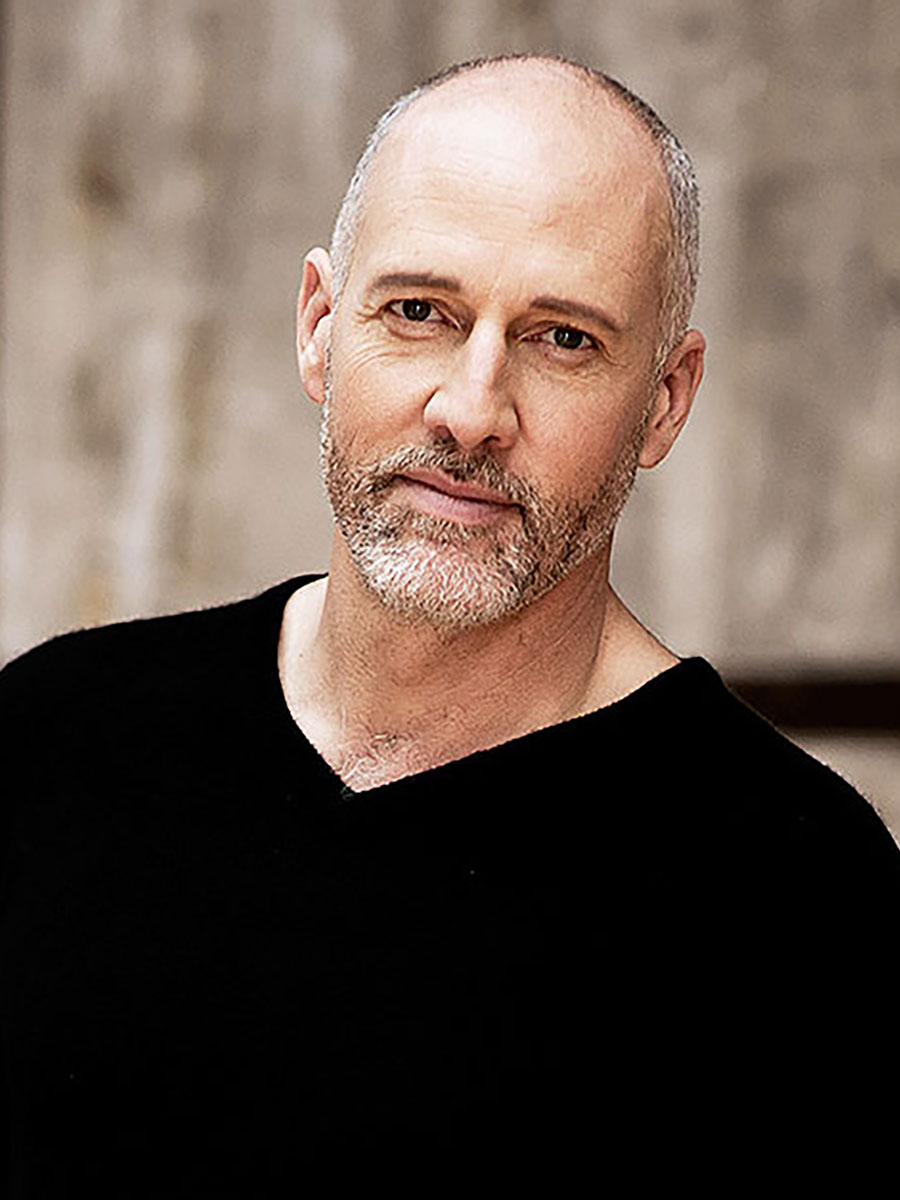
Paul Gay
Bass-Baritone
French bass-baritone Paul Gay has established a distinguished international career, particularly acclaimed in the French repertoire and in some of the most demanding works of the 20th and 21st centuries. A Chevalier de l’Ordre des Arts et des Lettres and Grammy Award winner, he has appeared at leading opera houses including the Opéra national de Paris, Bayerische Staatsoper, La Monnaie, Oper Frankfurt, Opernhaus Zürich, Teatro Regio di Torino, Opéra de Lyon and Maggio Musicale Fiorentino.
Among the defining roles of his career is Golaud in Debussy’s Pelléas et Mélisande, which he has performed at the Opéra national de Paris, La Monnaie, Oper Frankfurt, Norwegian National Opera, Shanghai Grand Theatre, Teatro Regio di Torino and Opéra de Lyon. His signature roles also include Méphistophélès in Faust and Saint François in Messiaen’s Saint François d’Assise, which he performed at the Bayerische Staatsoper under Kent Nagano.
Paul Gay opens the 2026/27 season with Stravinsky’s Oedipus Rex at the Calouste Gulbenkian Foundation in Lisbon, performing with the Gulbenkian Orchestra and Choir under Hannu Lintu. In April 2027, he returns to the Gran Teatre del Liceu in Barcelona as Alberto Roc in Thomas Adès’ The Exterminating Angel, conducted by the composer in Calixto Bieito’s production.
A major recent highlight was Paul Gay’s acclaimed staged debut in the title role of Enescu’s Œdipe at the Bregenzer Festspiele, in a new production directed by Andreas Kriegenburg and conducted by Hannu Lintu with the Wiener Symphoniker. He had previously performed the role in concert in London and Bucharest under Vladimir Jurowski. Further recent engagements include Rocco in Fidelio at the Opéra National de Bordeaux and Alberto Roc in Thomas Adès’ The Exterminating Angel at the Opéra national de Paris.
His repertoire further encompasses Verdi roles including Philippe II in both the French and Italian versions of Don Carlos, as well as Ramfis, Sparafucile and Walter.
-
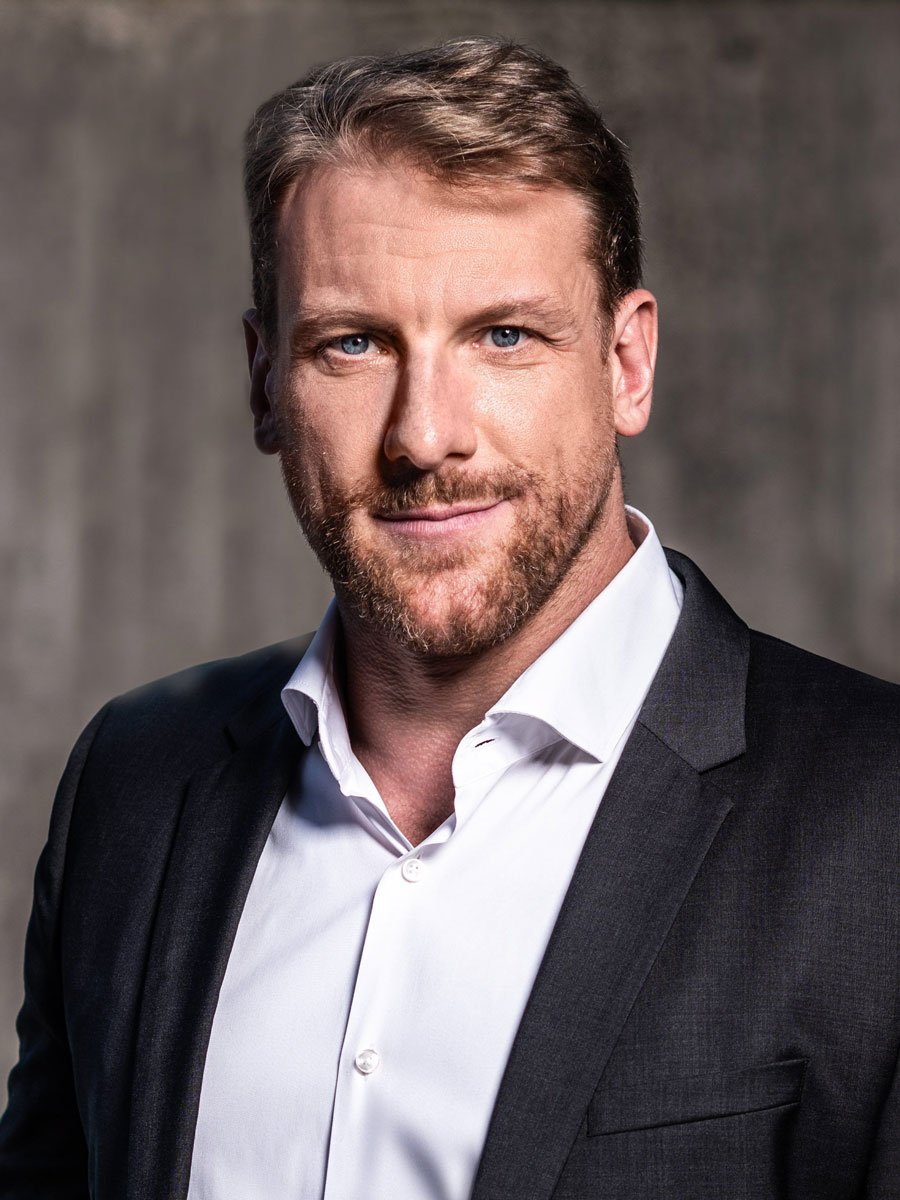
Günther Groissböck
Bass
Günther Groissböck thrills audiences on the world’s opera and concert stages with his unmistakably noble vocal timbre and breathtaking expressive power. After studying at the University of Music and Performing Arts Vienna, the Austrian bass was a member of the Vienna State Opera ensemble in the 2002/03 season, before joining the ensemble of Zurich Opera from 2003 to 2007.
He made his debut at the Salzburg Festival in 2002, where in 2014 he celebrated his widely acclaimed role debut as Baron Ochs (Der Rosenkavalier). In 2011, he made his debut at La Scala in Milan as well as at the Bayreuth Festival as Hermann (Tannhäuser). He has been a regular guest at Bayreuth ever since, appearing in roles including Gurnemanz (Parsifal), Fasolt (Das Rheingold) and Pogner (Die Meistersinger von Nürnberg).
One of the most sought-after singers in his Fach, he appears regularly at the world’s leading opera houses.
In 2021, he took on a new artistic challenge with his widely acclaimed directorial debut, Tristan Experiment, at the Theater an der Wien. This was successfully followed in 2023 by his staging of Don Carlo for Oper Klosterneuburg.
Most recently at the Vienna State Opera, he has sung Ochs (Der Rosenkavalier), King Heinrich (Lohengrin), Landgrave Hermann (Tannhäuser), Sarastro (Die Zauberflöte), Orest (Elektra), King Marke (Tristan und Isolde), Gurnemanz (Parsifal), Hunding (Die Walküre) and Hagen (Götterdämmerung).
Claude Debussy
Igor Stravinsky
The first programme of Hannu Lintu’s fourth season as Music Director of the Gulbenkian Orchestra highlights Stravinsky’s magnetic work Oedipus Rex. Based on Sophocles’ play of the same name, which tells the tragedy of a man unable to escape the destiny foretold to him, the composer collaborated with Jean Cocteau on the libretto for the work, which he described as an ‘opera-oratorio’, instructing that it should be staged with minimal movement and the singers’ faces concealed by masks.
Photo © Jorge Carmona
Sponsor Gulbenkian Music

The Calouste Gulbenkian Foundation reserves the right to collect and keep records of images, sounds and voice for the diffusion and preservation of the memory of its cultural and artistic activity. For further information, please contact us through the Information Request form.