
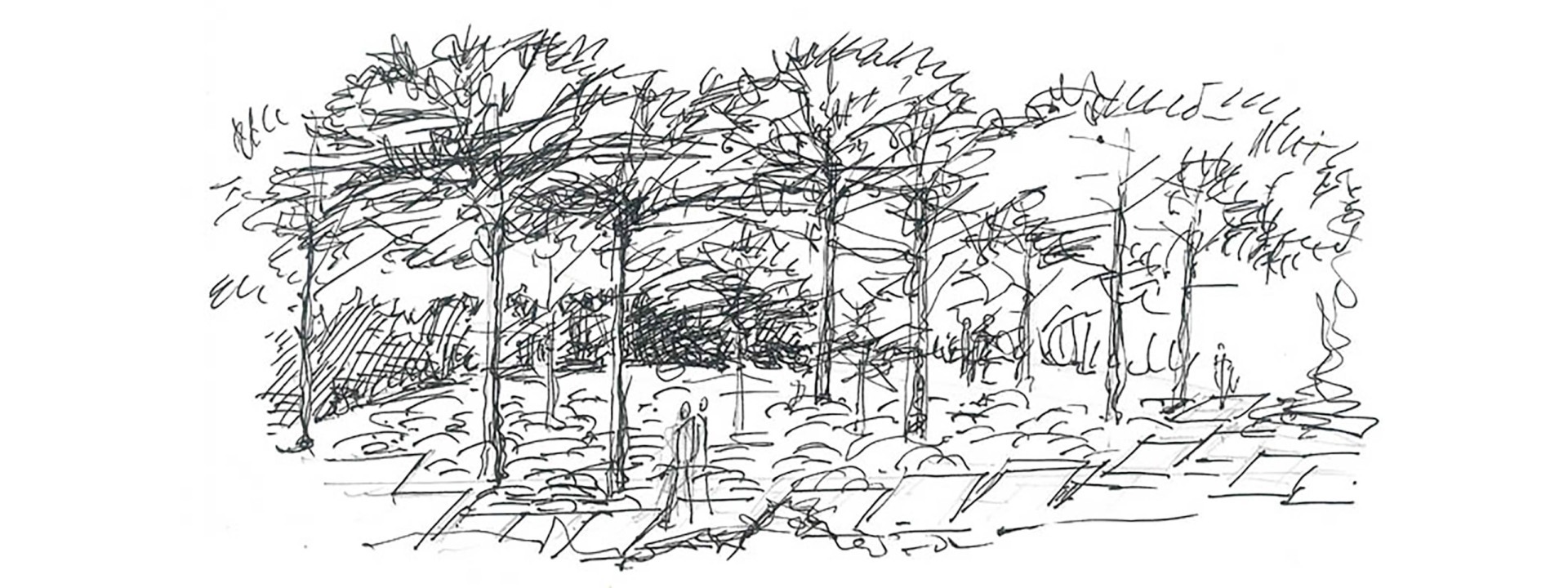
Gulbenkian Garden Rehabilitation Project 2000–2014
Due to the need to install a new irrigation system, the board of Directors of the Calouste Gulbenkian Foundation decided, in November 1999, to launch a third phase of rehabilitation in the Garden.
In March 2000, Gonçalo Ribeiro Telles began a study for the rehabilitation of the Calouste Gulbenkian Park. This new phase, in addition to installing a new irrigation system, aimed to:
Previous conservation and maintenance actions had already taken place.
Although different reasons at different times prompted intervention in the Garden, there is a clear continuity in these efforts:
A garden, as a living system, requires ongoing care determined by its own natural evolution, “where each element follows the cycle of being born, growing, reproducing, and dying” [i].
Principles of Intervention
The Garden, originally designed in 1961 by António Facco Viana Barreto and Gonçalo Ribeiro Telles, had reached maturity and followed its natural and cultural development. Over time, it designs itself through the balance between natural order and cultural design. By 2000, the Garden presented:
Ribeiro Telles saw this maturity as an opportunity to strengthen the principles set in 1961 while creating new spaces shaped by the transformations brought by 40 years of natural and cultural development.
“In designing the Garden, the form of the groves and clearings, the presence of water, and the interplay of light and shadow were intended to reflect Mediterranean culture and the essence of our landscapes. This guiding principle continues in the current recovery project.”
On March 15, 2001, a team of young landscape architects, led by Gonçalo Ribeiro Telles, presented the principles and methodology that would guide the Garden’s rehabilitation.
Beyond the immediate practical needs, Ribeiro Telles approached the Garden as:
Methodology
Initially, the team planned to develop the project in homogeneous sections. During the process, this approach was revised. They proposed developing the project in five successive phases, carried out simultaneously across four operational units, which represented significant areas of the Garden. A review of these units (later expanded to five) shows strong continuity with the sections defined in 1961 for the original project.
Documents of this phase
[i] Gonçalo RIBEIRO TELLES , “Gulbenkian Recuperação e recriação do Parque” in Revista Jardins, n.º3, Dezembro de 2002.