Amadeo de Souza-Cardoso

Untitled (Clown, Horse, Salamander)
c. 1911 – 1912 (attributed date)

Gallery


Object details

Author(s)
Amadeo de Souza-Cardoso (1887 – 1918)
Title
Untitled (Clown, Horse, Salamander)
Date
c. 1911 – 1912
Materials and media
Paper; Gouache
Technique
Gouache on paper
Dimensions
Height 23,80 cm; Width 31,80 cm
Inventory no.
77DP345

Inscriptions

Type
Signature
Description
A.S.C.
Position
Lower left corner
Type
Title
Description
CLOWN CAVALO SALAMANDRA
Position
Lower left corner

Incorporation

Type
Donation
Provenance
Lucie de Souza Cardoso
Date
1977

Text

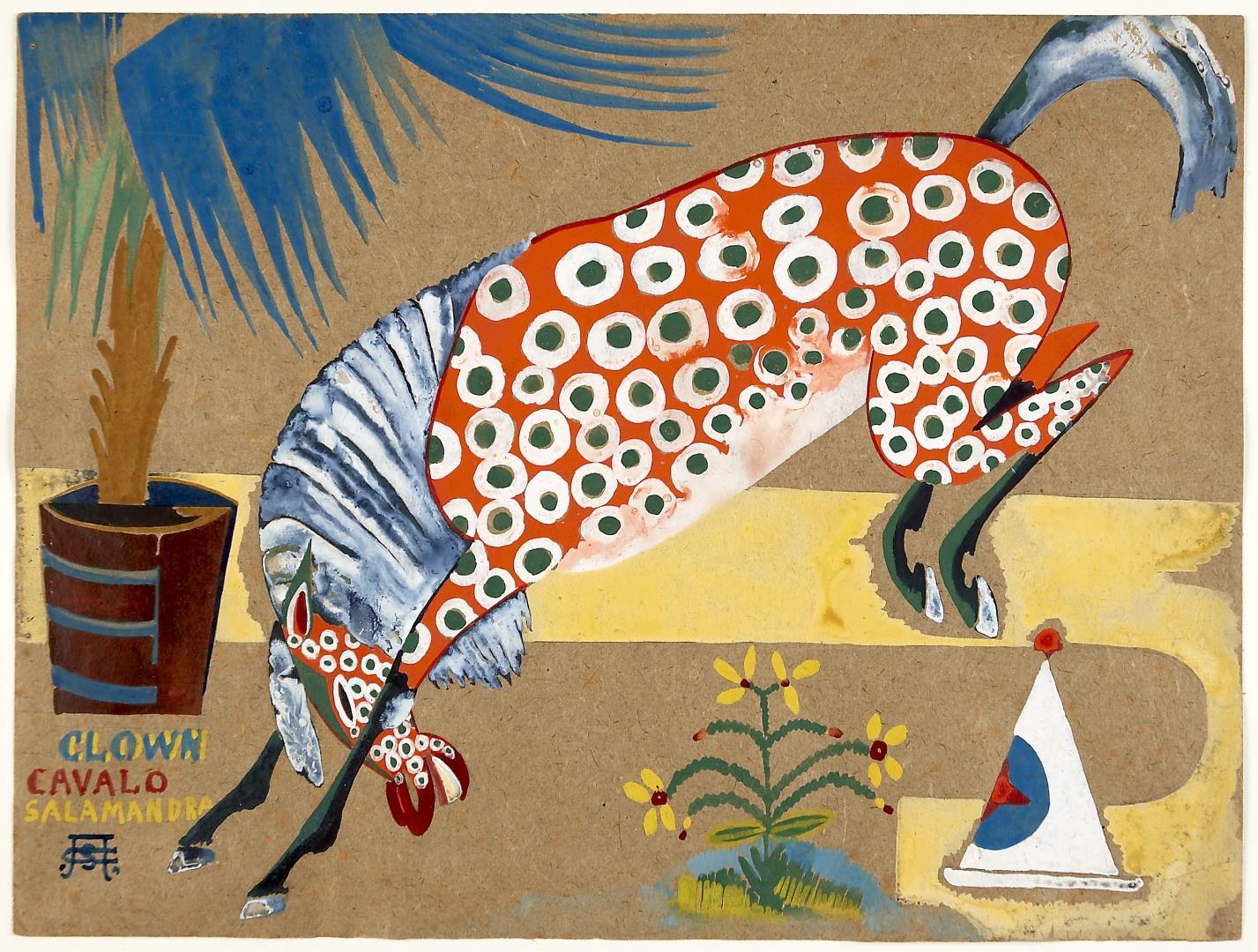
Clown, Cavalo, Salamandra [Clown, Horse, Salamander] is the most frequently reproduced of Amadeo’s gouaches and was probably featured in his first exhibition with Modigliani (1911).[1] Although his work at the time was dominated by drawing, this brief foray into gouache would prove decisive, leading him to the pictorial experiments that he would later undertake in oil, imbuing the graphic simplicity of his compositions with the bright colours and intense materiality that became his trademarks and exploring new ways of representing rhythm and movement in his usual hunting themes.

Two identical preparatory drawings of this gouache (see I and II) are known to exist, in which the appearance of the horse appears to be copied from a Japanese parchment by Fujiwara Takanobu (12th century).[2] However, the figure of the mounted horseman disappears from the gouache and is replaced by an unlikely colourful clown’s hat. Despite not being decorated in the drawing, the horse, the work’s sole character, acquires the extravagant pigmentation of a salamander in the form of white and green circles (exaggerating the spotted horse of the Japanese icon) amid a hotchpotch of pictorial signs. In the year in which Franz Marc began to paint blue horses and before the Robert Delaunay had invented the orphic circle, these spots became a recurring motif in Amadeo’s work, which he manipulated variedly as a strategy to reconsider the ideas of representation that were most attacked by the avant-gardes: the rhythm, space and vitality.

Unlike the exotic Douanier Rousseau-style jungle seen in the drawing, with its schematic, minimal framing of plants in the foreground and a palm tree in the background, the palm tree in the gouache is placed in a flower bed. The scene depicted seems to be situated in an (unfinished?) interior traversed by a yellow patch that unites the various parts of the image, which are characterised by flat space and varying scales. Since the inscription Clown, Horse, Salamander is not known to have any putative narrative referent, the apparently random combination of words appears to herald the futurist use of this device that he would subsequently employ. However, the uncanny illustration evokes the festive atmosphere characteristic of the programme of visual euphoria pursued by Amadeo, which took the circus as a central motif of modern art and popular culture (bearing coincident parallels with Seurat’s famous work[3]) in order to explore, in a visually appealing manner, the pictorial possibilities offered by lively colours and drawing.


Afonso Ramos

June 2013

[1] The exhibition of Amadeo and Modigliani’s work took place in the Portuguese artist’s studio at no. 3 rue Colonel Combes, in Paris. According to the artist, he presented ‘drawings and a few works on cardboard’ along with gouaches and seven sculptures by Modigliani. The guests of honour included Apollinaire, Brancusi, Derain, Max Jacob and Picasso.

[2] The original, Handscroll of Horses, is in the British Museum, London. Cf. Amadeo de Souza Cardoso: diálogo de vanguarda, Lisbon: CAM/FCG, 2006, p. 187.

[3] Seurat’s emblematic work Le Cirque (1890), whose palette is partially echoed here, appears to have been directly cited by Amadeo in a drawing produced in the same year.

Cookies settings

Cookies Selection

This website uses cookies to improve your browsing experience, security, and its website performance. We may also use cookies to share information on social media and to display messages and advertisements personalised to your interests, both on our website and in others.