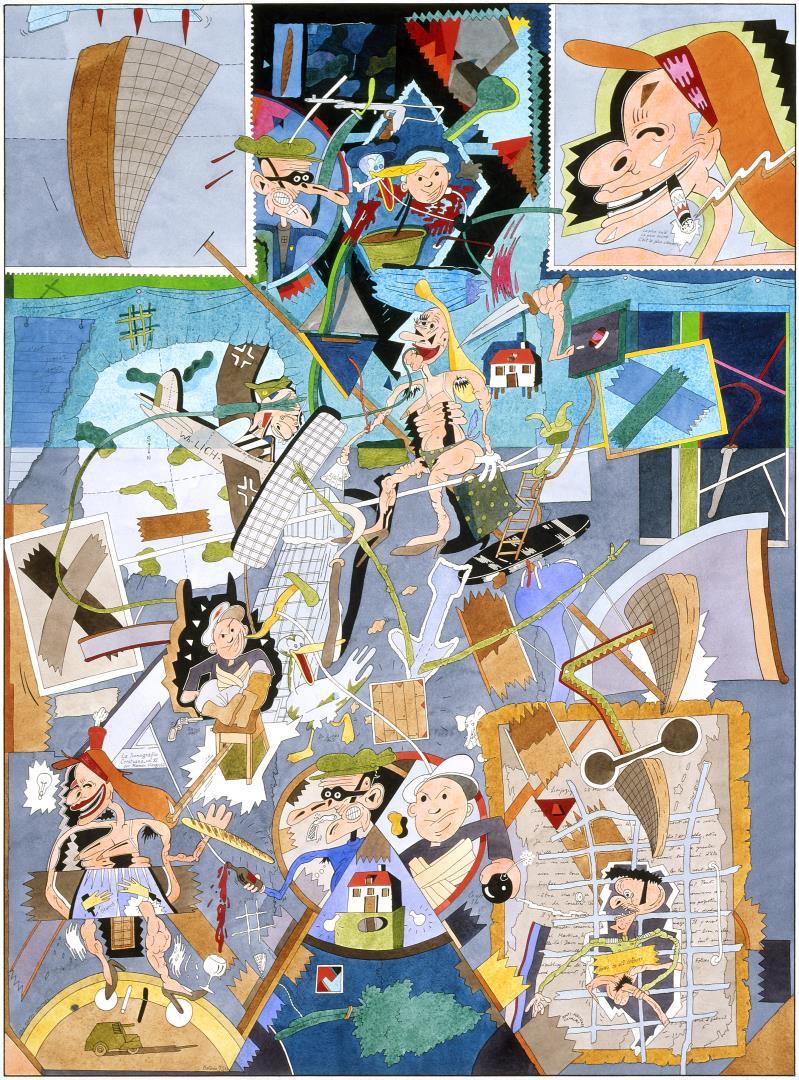
Eduardo Batarda

She takes chances (...ce soir, 7 heures)
Dec 1973

Gallery


Object details

Author(s)
Eduardo Batarda (Coimbra, Portugal, 1943 – Lisbon, Portugal, 2025)
Title
She takes chances (...ce soir, 7 heures)
Date
Dec 1973
Materials and media
Paper; Watercolour; Indian ink
Technique
Watercolour on paper; Watercolour on paper
Dimensions
Height 77,50 cm; Width 57,00 cm
Inventory no.
98DP1727

Inscriptions

Type
Signature
Description
Batarda
Position
Front, lower left corner
Type
Date
Description
73/12
Position
Front, lower left corner

Incorporation

Type
Purchased
Provenance
Eduardo Batarda (1943-2025)
Intermediary
CAMJAP/FCG
Date
February 1998

Text

In this watercolour, originally titled Electric Night Woman, Eduardo Batarda uses certain types of blues – including lapis lazuli – for the first and only time. The current title emerged from the montage of two inscriptions on the work. This is an example of the type of figuration Batarda was exploring from around 1970, in which the acerbic humour of the seedy world of comic strips voluntarily contrasts with the slow execution of minutiae in the technique the artist has chosen. Unlike conventional comic strips, Batarda’s painting is not subdivided into sequential narrative compartments, but rather, we see a cumulative composition in which various types of figuration converge: child-like cartoon-inspired character types, war planes, slices of cake (a pun on the English expression ‘piece of cake’), expressionist webs and sexually explicit images, all articulated with political and art-historical references. The captions that seem to attach to some of the figures or that float in isolation are, in fact, somewhat disconcerting additions (for instance the lyrics of the French song Les Baisers). Although these take on a pictorial function, they also allow new levels of meaning to accrue in a caustic critique of the cultural, political and artistic milieu of the time, and on the (im)possibility of any kind of relationship between these registers. The fact that one of these elements is a forged letter, scarcely legible because partially obscured – we can see it’s from Leipzig, which at the time was in the GDR – together with the fact that the figures on the upper left and right corners are framed by the zigzag edging of stamps, also suggest that this painting (among others) was conceived as a vehicle for messages. Such communiqués are disguised by the multiplicity of associations and allusions to realities both real and fictional, disposed all over the surface of the work.


MPS

May 2010

Cookies settings

Cookies Selection

This website uses cookies to improve your browsing experience, security, and its website performance. We may also use cookies to share information on social media and to display messages and advertisements personalised to your interests, both on our website and in others.