Eduardo Batarda

No chão que nem uma seta
1975

Gallery


Object details

Author(s)
Eduardo Batarda (Coimbra, Portugal, 1943 – Lisbon, Portugal, 2025)
Title
No chão que nem uma seta
Translated title
On the floor like an arrow
Date
1975
Materials and media
Paper; Watercolour; Indian ink
Technique
Watercolour on paper
Dimensions
Height 78,70 cm; Width 58,50 cm
Inventory no.
DP1340

Inscriptions

Type
Signature
Description
Eduardo Batarda
Position
Front, lower left corner
Type
Title
Description
NO CHÃO QUE NEM UMA SETA
Position
Verso, lower right corner
Type
Date
Description
1975
Position
Front, lower left corner
Type
Signature
Description
Eduardo Batarda
Position
Verso, lower right corner
Type
Date
Description
1974
Position
Verso, lower right corner

Incorporation

Type
Purchased
Provenance
Eduardo Batarda (1943-2025)
Intermediary
Serviço de Belas-Artes
Date
December 1975

Text

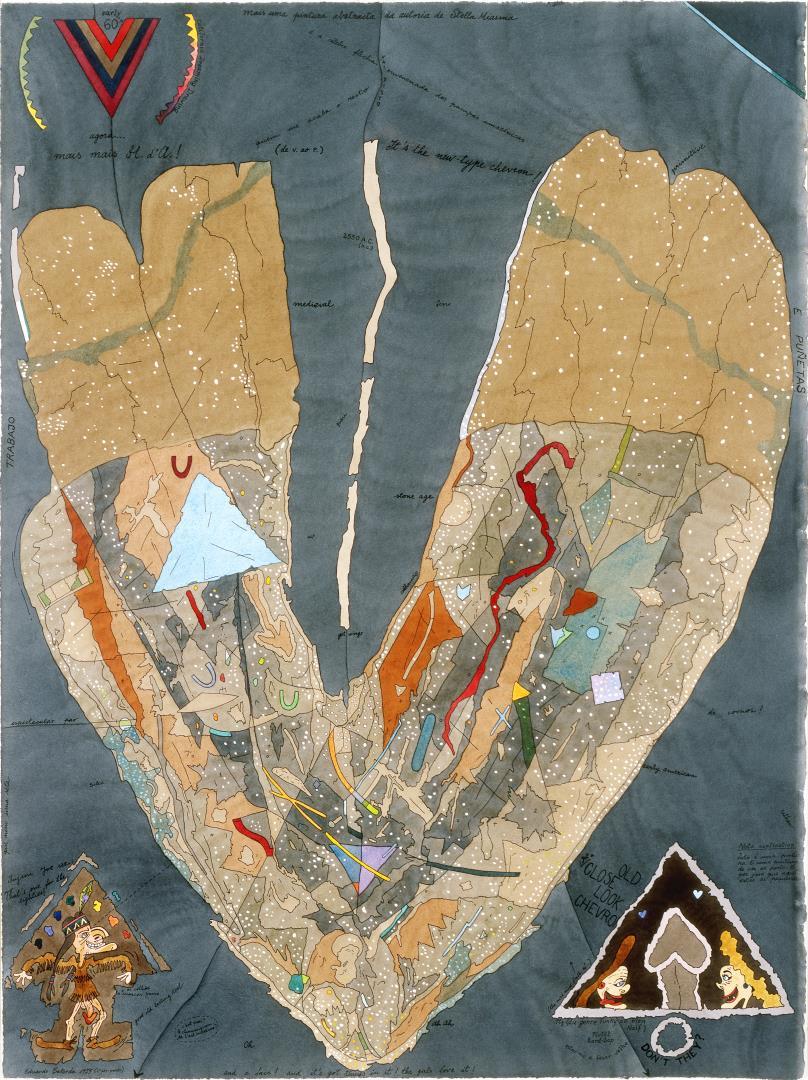
In this watercolour, acquired for the collection after Batarda’s exhibition at the end of his study grant in 1975, the highly accomplished drawing is – as in Ao Exp. Abs. 1 and 2 – reminiscent of cartography. But here, the grouped elements of the painting draw a V on a dark grey ground. From the bend in the V, a pale, discontinuous line emerges. Though irregular, it suggests a road, while at the same time reading as a descending arrow. This is the last painting that Batarda made before a three-year break. His original idea had been to call the work Chevron, a word that appears in two of the inscriptions on this painting. When returning to aquarelle in 1978, Batarda revisited this work in two other watercolours with Chevron in their titles. Chevron is not only the name of one of the oldest American petrol companies, but also means a V-shaped military emblem, sewn onto the sleeves of army uniforms to indicate the ranking and number of years that the wearer has served.

The verbal inscriptions in the painting include viewing instructions (drolly inviting the viewer to read the smallest letters by stepping closer to the painting), self-deprecating remarks, slang and chronological reference marks, suggesting that this cartographic reading also contains a panoramic view of art history (and of the artist’s own work) which moves downwards, as if it were depressingly drowning or immersing into the earth, to persist only as an archaeological comment on its own past.


MPS

May 2010

Cookies settings

Cookies Selection

This website uses cookies to improve your browsing experience, security, and its website performance. We may also use cookies to share information on social media and to display messages and advertisements personalised to your interests, both on our website and in others.