
Júlio Pomar
Gallery
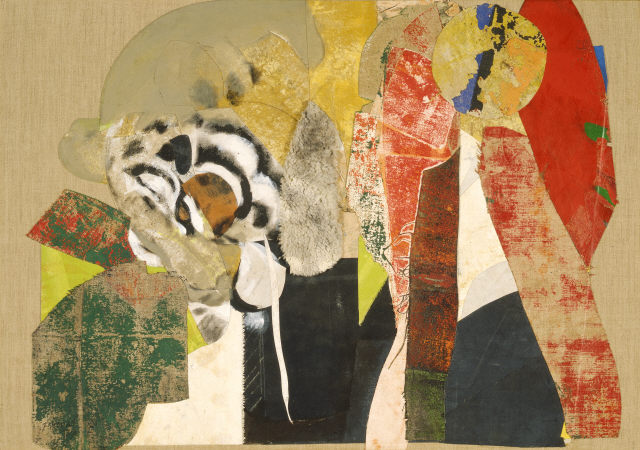
Pomar began to work with collage – predominantly using pieces of cut-up canvas – and to experiment with assemblage towards the end of the 1960’s. The cutting and gluing of pieces of canvas followed his change from oil to acrylic. The latter’s possibilities of fast drying and greater opacity allowed for the application of large color planes while covering the more evident traces of individual brushstrokes. From this resulted a series of paintings with a more graphic, almost industrial, character. The transition from the juxtaposition of blocks of color, a pastiche of collage, to actual collage, through the substitution of painted surface by surfaces composed of pieces of painted canvas in part or the whole of the canvas, occurred thus almost natural.
In Le Luxe the glued cut-outs can be seen in the light of Matisse's legacy of “drawing with scissors”, which Pomar appropriated, transformed and commented on in several other works, but should probably be related first of all with the three-dimensional assemblages he was then experimenting with. The glued elements in the work are not only canvas but also other materials such as paper and even synthetic hair, and they are assembled in order to evoke the body of a tiger curling over itself without losing their individual formal character.
Although it is not clear in this particular painting, the theme of the tiger was explored in a series which directly associate it with elements of the female body, imbuing the animal with an erotic charge, more or less recognizable in each individual painting. The painter justified his choice of the tiger as an explicit refusal of the classical themes in painting, for “the subject in painting (what is represented) is more the place in which you play than the actual result of the game.”* In fact, though, the tiger is an established literary reference and leads, in Pomar's association of the animal to the female body and eroticism, to various more or less obvious symbolic readings. In this painting, the title is reminiscent of the atmosphere of “luxe, calme et volupté” [luxury, calm, and delight], a verse from Charles Baudelaire’s Les Fleurs du Mal [Flowers of Evil], while the title repeats that of a 1904 painting by Matisse which shows, in vibrant Fauvist colors, swimmers leisurely reclining on a water shore.
* Júlio Pomar. 1986. Da Cegueira dos Pintores (trans. Pedro Tamen). Lisboa: Edições D. Quixote, p. 12. Italics in the original.
MPS
May 2010
Object details
- Author(s)
- Júlio Pomar
- Title
- Le Luxe
- Date
- 1979
- Materials
- Canvas
- Dimensions
-
Type Value Unit Section Width 116 cm Height 81 cm Height 83,5 cm Depth 4,5 cm Width 118,5 cm - Inventory no.
- 83P766