Eduardo Batarda

I Like Art ou a Perspectiva do Costume com Água no Bico
1967 – 1968

Gallery


Object details

Author(s)
Eduardo Batarda (Coimbra, Portugal, 1943 – Lisbon, Portugal, 2025)
Title
I Like Art ou a Perspectiva do Costume com Água no Bico
Translated title
I like art, or the usual perspective with a twist
Date
1967 – 1968
Materials and media
Wood; Acrylic paint
Technique
Acrylic paint on wood
Dimensions
Height 195,00 cm; Width 170,00 cm
Inventory no.
81P697

Inscriptions

Type
Signature
Description
Batarda
Position
Front, left side margin
Type
Date
Description
67-68
Position
Front, left side margin

Incorporation

Type
Purchased
Place
Lisbon
Provenance
Manuel de Brito
Date
July 1981

Text

ARTIST STATEMENT

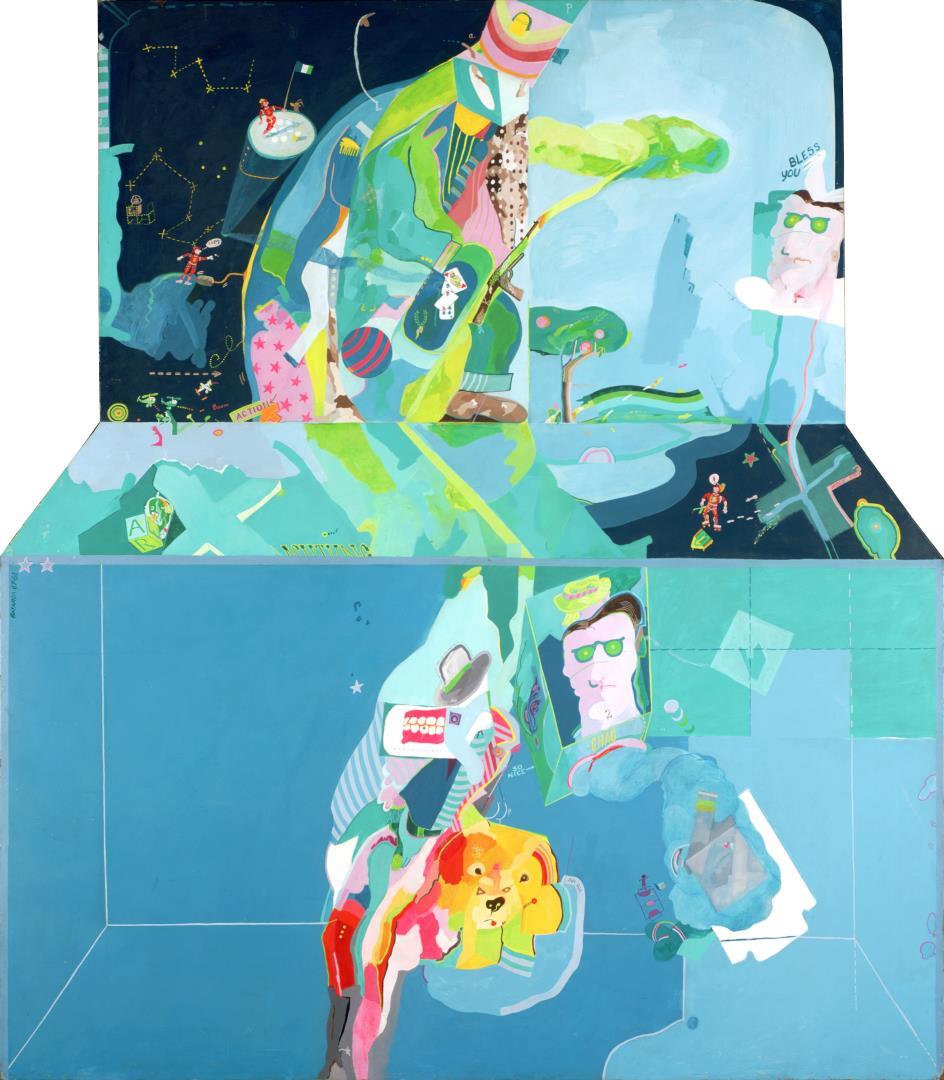
Considered by the artist himself to have been the pièce de résistance of his first individual exhibition (1968), this work was painted on a curious polygonal stretcher, enabling the play of trompe l’œil  in the lower section, a cube or box projecting into deep space, but with the artifice of its perspectival construction exposed by the extension of its orthogonals. Using fluorescent paint, Eduardo Batarda obtained unusual contrasts and luminosities, but these effects have dissipated over time. With cynical humour, the painting evokes various elements of vernacular language, politics and religion, while simultaneously commenting on art history. The work also alludes to strategic maps, to landscape painting and its relations with topography, property and abstraction, and to the earth seen from space (‘the earth is blue’, noted Yuri Gagarin, the first man to travel in the earth’s orbit). Various motifs are distinguishable, including a Hitler-like head, decapitated and wearing dark glasses. A bird saying ‘bless you’ seems both to refer to the ironic idea of Hitler being ‘blessed’ (in English) and to respond to the ‘ACHTUNG’ which appears in cut-out letters on the edge of the box, as if spit out in an apoplectic speech of the Nazi leader. This Hitlerian figure is repeated on the lower panel, with the number 2 and a colonial hat, together with the inscription ‘CHAG’, part of the Jewish greeting for feast days, ‘chag sameach’ (‘happy holidays’). At the same time, it evokes other words: Chagall, chaga (Portuguese for both wound and nasturtium), KAG, CAG (Cape Verde, Angola and Guinea Bissau), all implicit allusions to the Portuguese Colonial War.

Other images and textual inscriptions invoke further associations: the artist’s strategy is to establish connotations, ambiguities and double (or triple) entendres, to some extent deployed to bypass censorship, but above as part of the language of painting itself. The tiny figure inside one of the sketched boxes/cubes floating in space is surmounted by a comic-like speech bubble with the somewhat ironic inscription ‘I like art,’ reminiscent of the slogan used for Eisenhower’s 1952 presidential campaign, ‘I like Ike.’ However, being part of the title [the expression appears in English in the Portuguese title], the expression invites us to reflect upon its literal meaning: to like art (or painting) because it removes all hierarchies, flattening them onto the same plane, linking them together, putting everything into the same basket (or, in this case, into the same box), while simultaneously commenting the tradition and the formal specificity of this kind of telling histories, calling forth, for example, classical perspective. Hence, in the painting as in the title, ‘the usual perspective’ alludes to the work’s capacity to mask meanings with hidden intentions.


Mariana Pinto dos Santos

May 2010

Cookies settings

Cookies Selection

This website uses cookies to improve your browsing experience, security, and its website performance. We may also use cookies to share information on social media and to display messages and advertisements personalised to your interests, both on our website and in others.