José de Almada Negreiros

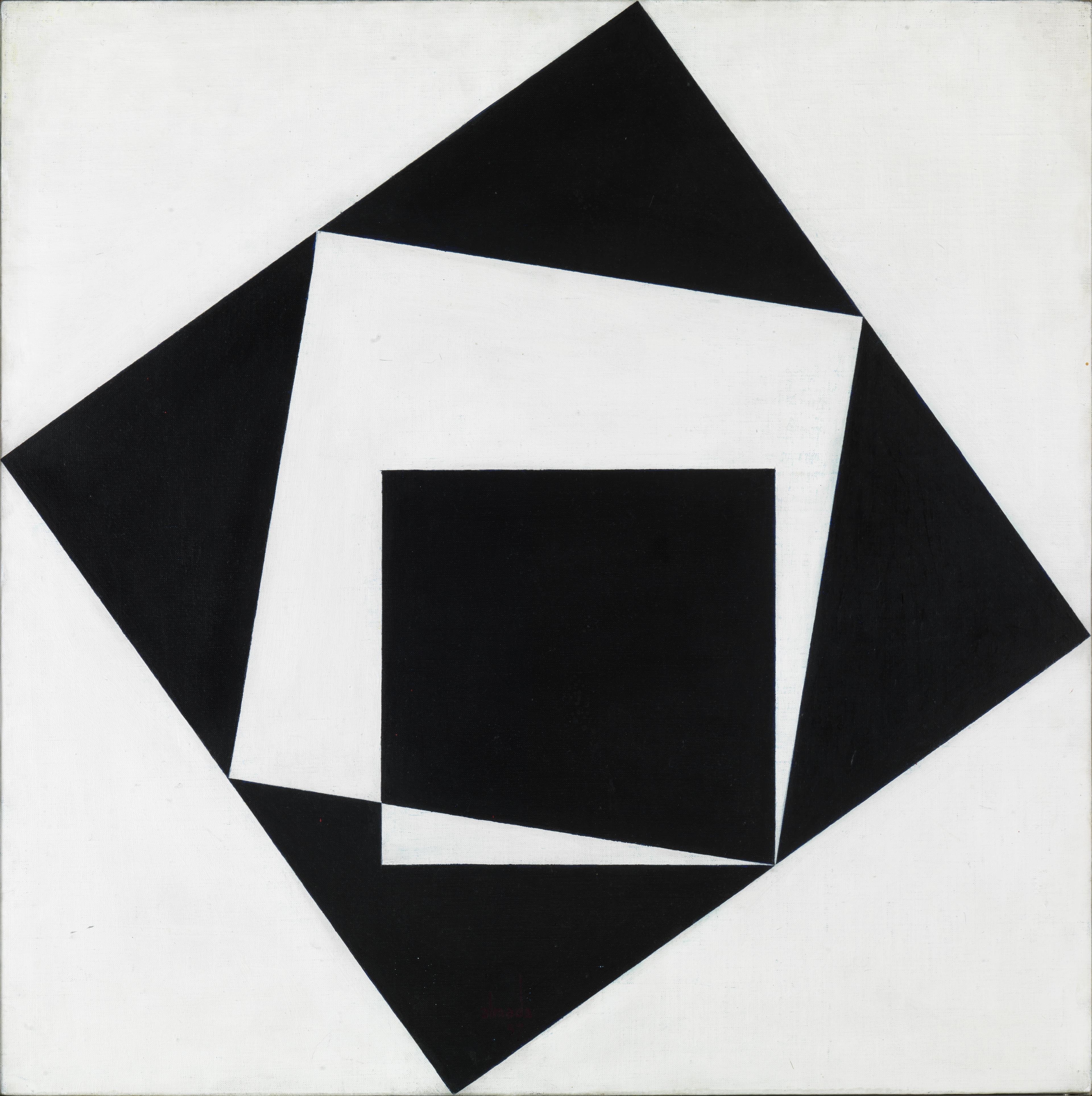
Door of Harmony
1957

Gallery


Object details

Author(s)
José de Almada Negreiros (Cidade da Trindade, São Tomé e Príncipe, 1893 – Lisbon, Portugal, 1970)
Title
Door of Harmony
Date
1957
Materials and media
Canvas; Oil
Technique
Oil on canvas
Dimensions
Height 60,00 cm; Width 60,00 cm
Inventory no.
83P65

Inscriptions

Type
Signature
Description
almada
Position
Front, lower margin, centre
Type
Date
Description
57
Position
Front, lower margin, centre

Incorporation

Type
Purchased
Provenance
Arqtº José Almada Negreiros
Date
May 1983

Text

This work is part of a series composed by four geometrically-abstract paintings, all belonging to the collection of the CAM, which establish, theoretically, a numerical unity: Porta da Harmonia [Door of Harmony], O Ponto de Bauhütte [The Bauhütte Point], Quadrante I [Quadrant I] e Relação 9/10 [Relation 9/10] (according to the order intended by the author). Exhibited in the I Visual Arts Exhibition of the Calouste Gulbenkian Foundation (Lisbon, National Society of the Fine Arts, 1957), the jury awarded these paintings outside of the normal competition (won by Eduardo Viana). The poetress Sophia de Mello Breyner Andresen defended the justice of this award in a newspaper piece about the exhibition:

‘It is profoundly just that Almada’s paintings were given an out-of-competition award, because, to some extent, they actually are on a different level as the other works exhibited. They do no longer partake of the existential, but of the essential, of the absolute and the abstract. That’s why I had the impression these paintings presided over the entire exhibition. Because they are sheer synthesis, the very law of proportion and harmony which underlies all things that are certain. And this is why such a profound sense of equilibrium, clarification and serenity arises from them. They immediately evoke Greece. Being one of the most modern works from the exhibition, it is also the one most connected to the art of Antiquity. This explains what I hold to be tradition when I say that in the Gulbenkian exhibition tradition was preferred to academism.’*


Sara Afonso Ferreira
May 2010


* Sophia de Mello Breyner Andersen, ‘Modernidade e tradição na exposição Gulbenkian’, in Diário Popular, January 9, 1958, p. 4 and 6.

Cookies settings

Cookies Selection

This website uses cookies to improve your browsing experience, security, and its website performance. We may also use cookies to share information on social media and to display messages and advertisements personalised to your interests, both on our website and in others.