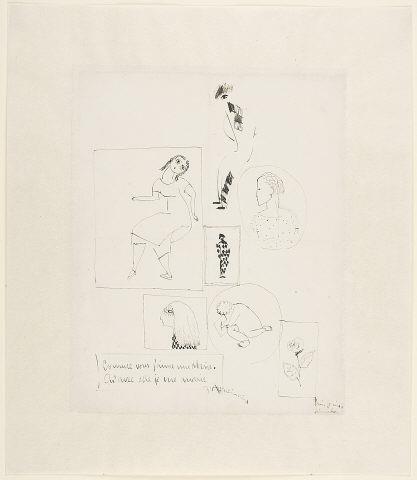
José de Almada Negreiros

Comme vous j'aime une Marie qu'avec elle je me marie
10 Jun 1919

Gallery


Object details

Author(s)
José de Almada Negreiros (Cidade da Trindade, São Tomé e Príncipe, 1893 – Lisbon, Portugal, 1970)
Title
Comme vous j'aime une Marie qu'avec elle je me marie
Date
10 Jun 1919
Materials and media
Paper; Fountain pen ink
Technique
Fountain pen ink on paper
Dimensions
Height 27,20 cm; Width 21,50 cm
Inventory no.
DP176

Inscriptions

Type
Signature
Description
Paris, 10 Juin 1919 / almada
Position
Lower right corner
Type
Date
Description
10 Juin 1919
Position
Lower right corner
Type
Geographic location
Description
Paris
Position
Lower right corner
Type
Undetermined
Description
Comme vous j'aime une Marie / Qu'avec elle je me marie / G. Appollinaire
Position
Lower left margin

Incorporation

Type
Purchased
Provenance
Jorge de Brito
Date
July 1983

Text

This work is without doubt part of the production of works Almada realized in the context of his work with the ‘Five Colors Club’,* a ballet group created in 1918 on the occasion of the creation and performance of O jardim da Pierrette [The garden of Pierrette], written by Almada himself. The club was formed by Almada and four young friends, addressed by nicknames: Tareca (Maria Madalena Morais da Silva Amado), Lalá (Maria Adelaide Burnay Soares Cardoso), Zeca (Maria José Burnay Soares Cardoso) and Tatão (Maria da Conceição de Mello Breyner). The performance of O jardim da Pierrette was a decisive moment for the genesis of Almada’s poetics of ingenuity, here related to topics seen as essential to creation such as childhood, imagination and spontaneity. Almada would further develop these themes during his stay in Paris between 1919 and 1920.

The French inscription in the drawing – ‘Comme vous j’aime une Marie / Qu’avec elle je me marie’, or ‘Like you I love a Mary / And so with her I marry’ – is a transcription of the last two verses of La Colombe [The Dove], one of the poems of Guillauime Apollinaire’s Bestiaire ou cortège d’Orphée [Bestiary or Orpheus’ procession], published in 1911 and reedited in 1919, the year Almada arrived in Paris. In a poem Almada wrote this same year, Histoire du Portugal par Cœur [History of Portugal by Heart] he again quotes this poem, as well as Le Dromedaire [The Dromedary], also from Apollinaire’s Bestiary. Almada’s poem, of which two handwritten versions belong to the CAM collection (DP243 and DP247), is one of the first statements of his poetics of ingenuity and directly related to his work with the ‘Five Colors Club’.


* Other works from the collection of the CAM also belong to this context. See the drawings and letters with inventory numbers DP167, DP168, DP183, DP184, DP244, DP245, DP246, DP248, DP249 and DP250.


SAF

May 2010

Cookies settings

Cookies Selection

This website uses cookies to improve your browsing experience, security, and its website performance. We may also use cookies to share information on social media and to display messages and advertisements personalised to your interests, both on our website and in others.