
'Re-Wall', Architecture and Material Life of Exhibitions
Event Slider
Date
- 16:30 / Cancelled 16:30 / Sold out Saturday, 16:30
Location
Engawa Space Centro de Arte Moderna GulbenkianThe public programme developed around ‘Re-Wall’ offers a broad reflection on exhibition architecture, reuse, sustainability, pedagogy and the material responsibility of cultural institutions. Bringing together architects, historians, curators, professors, students and institutional representatives, the event examines full-scale infrastructure to discuss how temporary exhibition structures are produced, what happens to the materials after an exhibition ends, and how materials, knowledge and construction systems can continue their life cycle.
Through a round-table discussion, public reconfigurations of the ‘Re-Wall’ system and an open debate with guests, lecturers and students involved in the process, the programme explores the future of exhibition structures in museums and cultural institutions, as well as the relationship between education, construction, material culture and institutional responsibility.
In so doing, a central question for contemporary architectural practice is raised: how to respond to the urgent need to reduce waste, not only by choosing new sustainable materials, but by rethinking existing resources and construction systems, designing reversible connections, extending life cycles and embracing reuse as a central act of design.
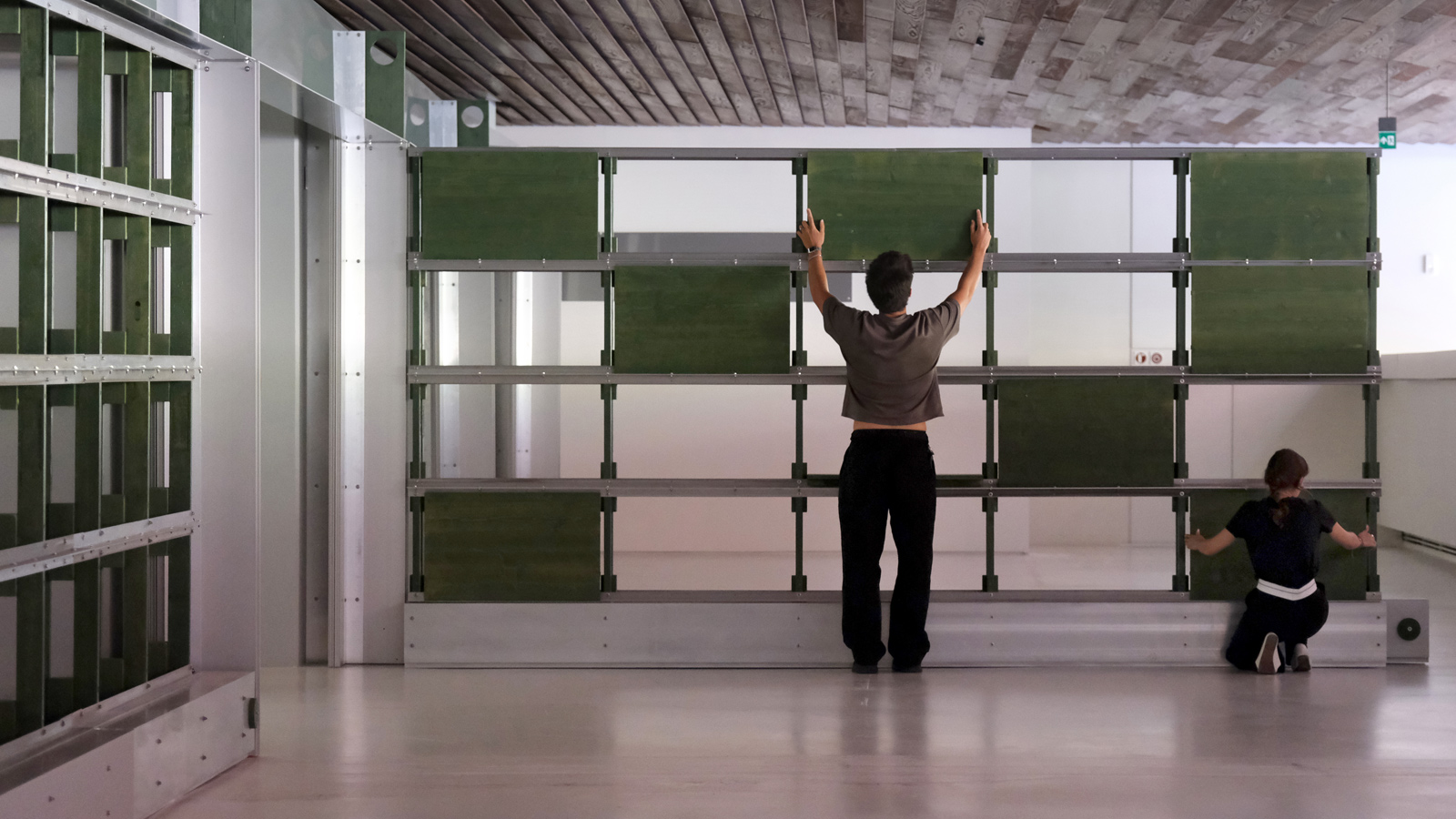
‘Re-Wall’ is an exhibition infrastructure created for CAM’s Engawa Space, coordinated by João Quintela and Marta Sequeira and designed and built in an academic context with architecture students from the Autonomous University of Lisbon.
Conceived as an architectural system against obsolescence, the project proposes a flexible, sustainable and circular approach to museography. Using surplus materials from the construction industry and remnants from previous exhibitions, ‘Re-Wall’ transforms discarded materials into a reconfigurable and reversible structure, designed to last, adapt and accommodate different uses over time. More than just an exhibition support, it stands as a constructed reflection on the future of architecture, education, curation and material reuse.
Programme
16:30 – 16:45 / Opening
16:45 – 17:45 / Round-table discussion: Sustainability, reuse and permanence in exhibition architecture
18:00 – 18:40 / Open microphone: readings of 'Re-Wall'
18:40 – 19:00 / Public reconfiguration of 'Re-Wall'
Co-organization

Support

The Calouste Gulbenkian Foundation reserves the right to collect and keep records of images, sounds and voice for the diffusion and preservation of the memory of its cultural and artistic activity. For further information, please contact us through the Information Request form.