
I Ate Civilization and It Poisoned Me
Event Slider
Date
- Closed on Saturday and Sunday
Location
João Paulo II University Library Building, 1st floorUniversidade Católica Portuguesa
In today’s globalized and interconnected world, we experience a landscape that is constantly shifting and filled with contradictions: polarized yet collaborative, highly technological and materialistic yet increasingly sensible to a holistic understanding of ecosystems. This fast-changing context, embedded in tensions and conflicts, is redefining our notions of time and space. Amongst this flux, multiple narratives emerge, and voices echo, juxtaposing constructed memories with lived experiences. These dynamics challenge our perceptions and worldviews, inviting us to imagine alternative futures, and expand our awareness of different perspectives on living collectively in its many forms.
This exhibition, organized in the context of the partnership between the international academic network The Lisbon Consortium and CAM – Centro de Arte Moderna Gulbenkian, was curated by the MA students in Culture Studies (seminar of Curatorial Practices), for the Amélia de Mello Foundation Gallery, at the Universidade Católica Portuguesa, in Lisbon.
Bringing together thirteen works from the Collection of CAM, ‘I Ate Civilization and It Poisoned Me’ offers a meditative reflection on the ever-evolving relationship between Nature and humans across past, present, and future. Presenting artists from different geographical and temporal locales, this exhibition weaves narratives that evoke our enduring dialogue with the natural world. The displayed works are situated along a spectrum of interconnected ideas: coevolution and coexistence (between the environment, humans, and technology); memory and fragmentation (of spaces, places, and landscapes); fragility (of memories, heritages, times, and humans’ relationships with Nature); alongside transformation and renewal (of natural, human, and emotional processes).
Ideas of coevolution and coexistence echo in Carlos Roque’s installation ‘We Came in Peace for all Mankind’ (2001) and João Louro’s ‘Brave New World’ (2014). Engaging with intergenerational and temporal topographies, the artists playfully reference humankind’s technological triumphs with an ironic bent.
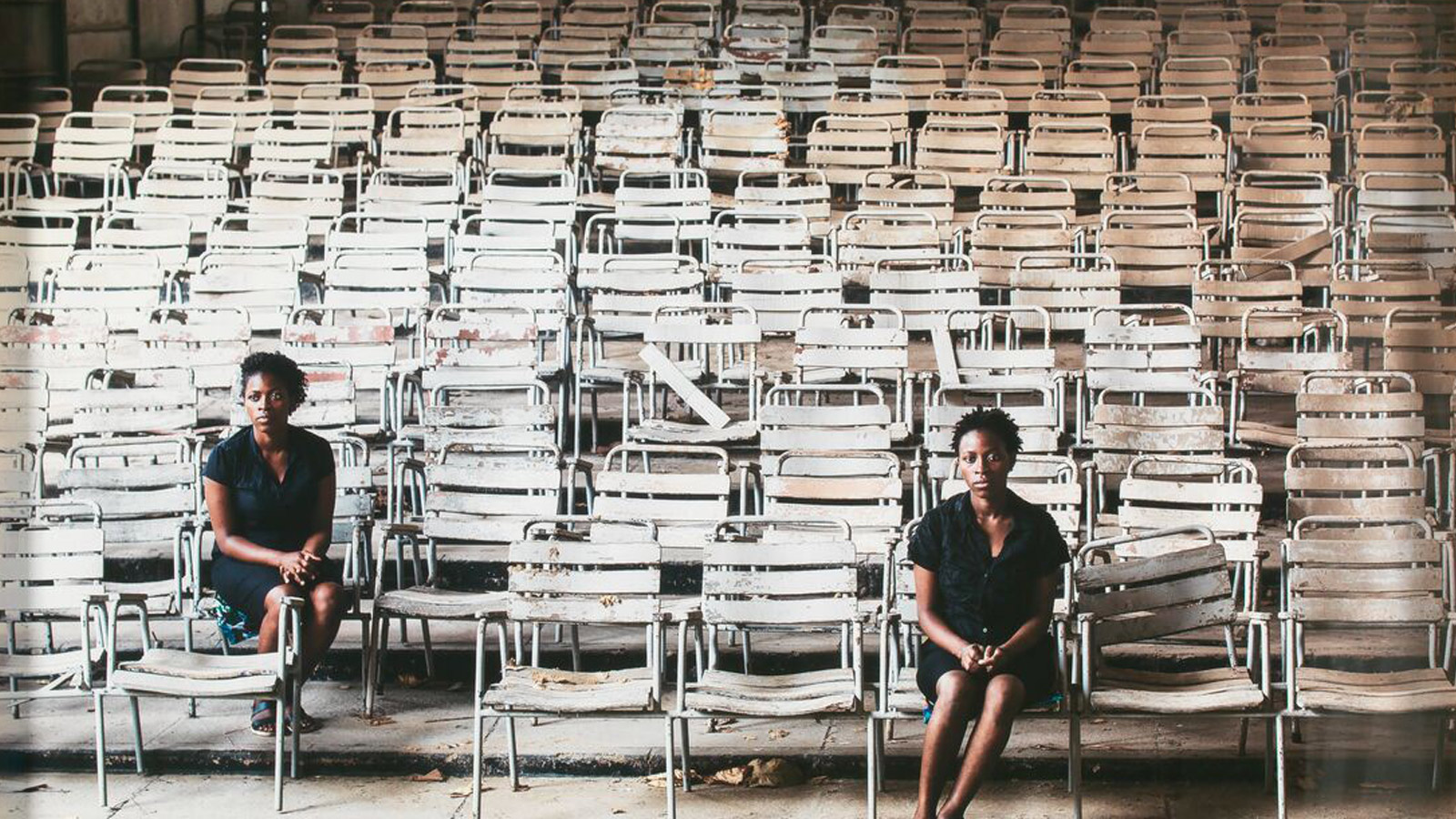
In turn, the relation between memory and fragmentation traverses across the works of Cecília Costa and Jorge Queiroz, who explore disjointed relations between time and space, immaterial and material. In a similar vein, Mónica de Miranda and Kiluanji Kia Henda work closely with concepts of liminality and remnants, inviting us to reckon with sites of destruction and desertion, nurturing desires for regeneration and reconnection with our natural surroundings.
Maria Capelo, Hugo Canoilas, and Carlos Bunga similarly engage these ideas, with their works blurring the boundaries between memory and imagination. Closely related to the concept of fragmentation, Ana Jotta’s leather piece ‘Heráldica’ (2000) and Clara Menéres’ ‘Fragmentos Arqueológicos de um Corpo Virgem I’ (1979) evoke fragility, drawing on tensions between permanence and ephemerality, ancient relics, and genealogies of power.
Transformation pervades Sara Sadik’s gamified simulation of the natural world, reflecting the interconnectedness between the changes in our inner and external landscapes. This concept also echoes across Sara Bichão’s poetic fusion of organic and synthetic materials, whose practice is guided by cathartic emotional pathways.
As we move through these multiple sensibilities and subjectivities, we are invited to not only observe but also engage in this space of reflection and possibility: to question what has been, to imagine what might be, and to recognize the delicate balance that defines our shared existence.
Credits
Main image
Mónica de Miranda, 'Twins e Plateau' (from the series 'Cinema Karl Marx'), 2017. CAM Collection © Mónica de Miranda
Artists Featured
Ana Jotta, Carlos Bunga, Carlos Roque, Cecília Costa, Clara Menéres, Hugo Canoilas, João Louro, Jorge Queiroz, Kiluanji Kia Henda, Maria Capelo, Mónica de Miranda, Sara Bichão and Sara Sadik.
Curatorship
Alunos do Mestrado em Estudos de Cultura (Turma 2024/2025): Csenge Bognár, Camilla Calamai, Carlotta Ceraudo, Elsa Damas, Marie Fassbender, Gaete Ganay, Triniti Goldsmith, Daniel Guedes, Colombe Lecoq-Vallon, Leonor Lisboa, Suzanne Marivoet, Mohamed Nejib Mokaddem, Giulia Paglia, Olga Rogova, César Sarno, Caroline Skäringer, Antonina Stanczuk-Sturgólewska, Elena Suppes, Sofia Talami, Mirian Vanda, Radina Velcheva, Lorena Vest and Anna Zörner.
Coordination
Luísa Santos
Exhibition Design
Anna Zörner
Camilla Calamai
Marie Fassbender
Mirian Vanda
Radina Velcheva
The Calouste Gulbenkian Foundation reserves the right to collect and keep records of images, sounds and voice for the diffusion and preservation of the memory of its cultural and artistic activity. For further information, please contact us through the Information Request form.