
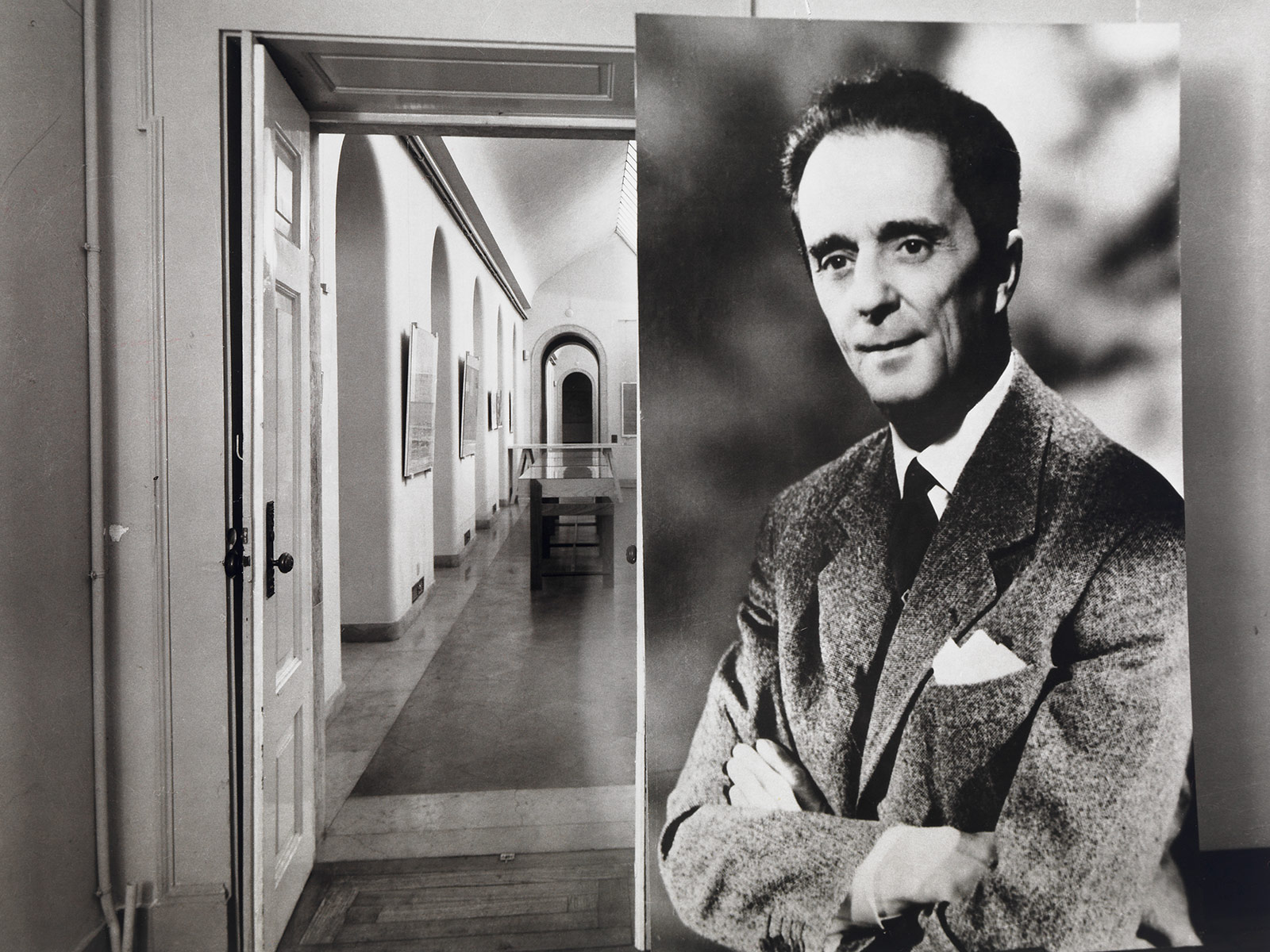
Carlos Ramos
1897 – 1969
Born in Porto on January 15, Carlos Ramos spent his childhood and youth in Lisbon, where he graduated in Architecture from the School of Fine Arts (1920), and had as colleagues, among others, Cottinelli Telmo (1897-1948), Luís Cristino da Silva (1896-1976) and Porfírio Pardal Monteiro (1897-1957), pioneers like him of the Modern Movement in Portugal.
Throughout his professional career, Ramos was the author of several projects, including the Havas Agency building (Lisbon, 1922), the Radio Pavilion of the Portuguese Oncology Institute (Lisbon, 1927-1933), the Dr. Navarro de Paiva Institute (Lisbon, 1931) and the Rovisco Pais National Leprosarium (Tocha, 1947).
He also planned the Marquês de Pombal Square (Lisbon, 1950; built between 1950 and 2000), and the Colonisation Pavilion for the Portuguese World Exhibition (1940).
Nominated architect-member of the hospital construction commission, Carlos Ramos was a member of the Municipal Art and Archaeology Commission and several public construction campaign commissions, and the first architect to be part of the Superior Council of Public Works. He was also President of the Portuguese Section of the International Union of Architects.
In parallel with his practice as an architect, Carlos Ramos developed an important pedagogical activity at the Porto School of Fine Arts, where he was professor (1940-1946 and 1948-1952) and director (1952-1967), introducing a series of changes in the teaching of architecture and contributing to its affirmation on the national panorama.
Although he didn’t produce much written work, Carlos Ramos expressed his theoretical thinking and his reflections on architecture in travel reports and in lectures given at national and international conferences and congresses in which he participated and directed.
The Calouste Gulbenkian Foundation dedicated the exhibition Carlos Ramos: a retrospective of his work (1986) to his oeuvre. Also, in connection with the Gulbenkian Foundation, he served on the selection and awards juries for the 1st and 2nd Exhibitions of Fine Arts (1957 and 1961), and was a member of the group of consultants for the competition and supervision of the construction of the headquarters and museum of the Calouste Gulbenkian Foundation (1961–1969).
Distinguished with the titles of Officer of the Military Order of Sant’Iago da Espada (1941) and Grand Officer of the Order of Public Instruction (1966), he also received the Lisbon Municipal Prize (1946), the Diário de Notícias Prize (1964) and the National Art Prize (1964).
The father of architect Carlos Manuel de Oliveira Ramos (1922-2012), with whom he collaborated on several projects, Carlos Ramos died in Porto on 1 July.
Ana Barata, João Figueira