Helena Almeida

Tela Habitada
1976

Gallery


Object details

Author(s)
Helena Almeida (Lisbon, Portugal, 1934 – Sintra, Portugal, 2018)
Title
Tela Habitada
Translated title
Inhabited Canvas
Date
1976
Materials and media
Cardboard; Chipboard
Technique
Gelatin silver print mounted on cardboard glued on chipboard
Dimensions
Height 167,50 cm (all 16 photographs); Width 126,50 cm (all 16 photographs); Height 40,00 cm (each photograph); Width 30,00 cm (each photograph)
Inventory no.
80FP381

Inscriptions

Type
Signature
Description
Helena Almeida
Position
Front, lower right corner
Type
Date
Description
76
Position
Front, lower right corner
Type
Signature
Description
Helena Almeida
Position
Verso
Type
Numeração do artista
Description
Trabalho n.º 5.
Position
Verso
Type
Title
Description
Tela Habitada
Position
Verso
Type
Date
Description
1976
Position
Verso

Incorporation

Type
Purchased
Provenance
Helena Almeida (1934-2018)
Date
1980

Text

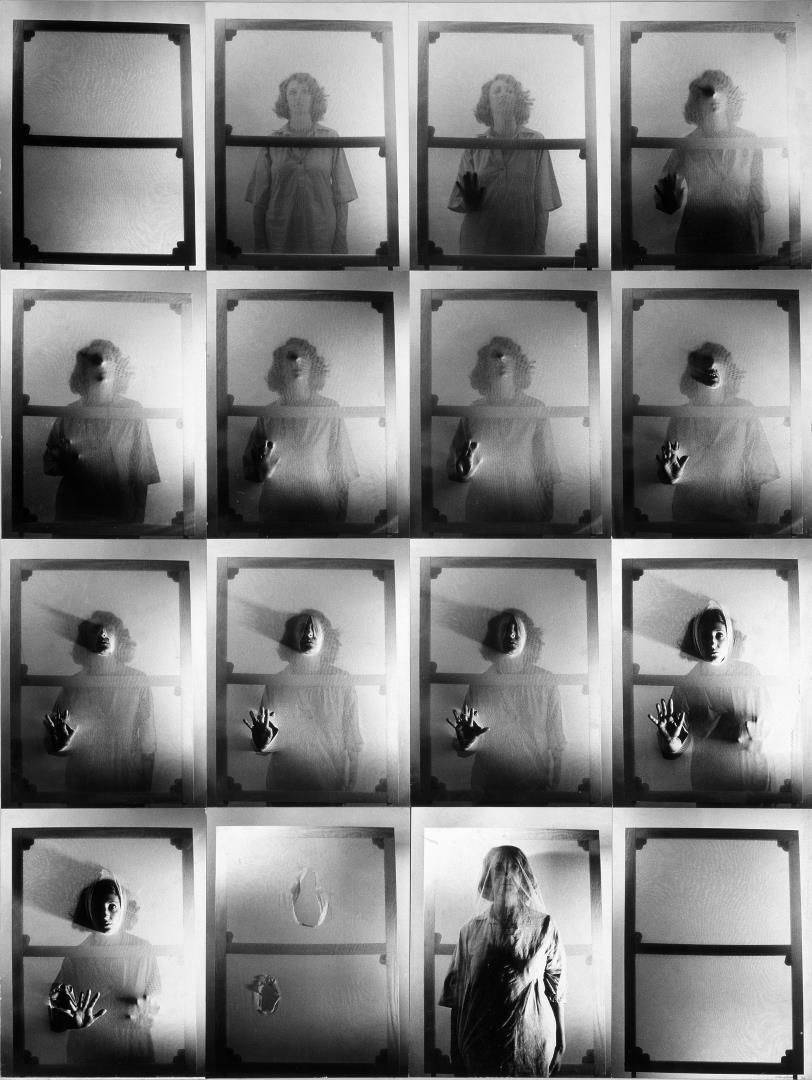
This work plays with the wooden stretcher bars of the structures that form the support on which the canvas is stretched. This structure is usually invisible to the viewer, but here exposed through the use of a semitransparent cloth, which reveals the contours of the artist’s body as she tries to “impress” herself or “penetrate” through that membrane.

Helena Almeida interprets thus a relationship between inside and outside, either as the interior projected as a body in relation to outside space, or through a constant assertion of the delimitation of spaces and the desire to overtake them, tear them apart, reveal their other side, to break down their barriers and pull out of them. She fulfills thus in another way the timeless axiom always repeated by the old master of Velasquez, Francisco Pacheco: “The image must jump out of the canvas”.

This photograph belongs to a series of works from the same period in which Almeida became conscious that it wasn’t enough to dismantle and deconstruct the support of painting, but that one had to fight as well the externality and, in some way, the tyranny of painting. A fight against the distance that exists in painting between being and representation, against the tyranny of the painter’s absent body in a life spent representing other bodies, against the danger of falling into yet another trap, that of self-portraiture. In her case we are not presented with self-portraits, but rather with self-representations.


IC

May 2010

Cookies settings

Cookies Selection

This website uses cookies to improve your browsing experience, security, and its website performance. We may also use cookies to share information on social media and to display messages and advertisements personalised to your interests, both on our website and in others.