Sonia Delaunay

Chanteurs Flamenco (dit Grand Flamenco)
1915 – 1916

Gallery


Object details

Author(s)
Sonia Delaunay (Hradyzk, Ukraine, 1885 – Paris, France, 1979)
Title
Chanteurs Flamenco (dit Grand Flamenco)
Date
1915 – 1916
Materials and media
Canvas; Glue; Oil; Wax
Technique
Oil on canvas
Dimensions
Height 174,50 cm; Width 143,00 cm
Inventory no.
PE114

Inscriptions

Type
Title
Position
Front, upper right corner
Type
Signature
Description
SONIA DELAUNAY
Position
Verso, central left grid

Incorporation

Type
Purchased
Provenance
Sonia Delaunay (1885-1979)
Intermediary
Fundação Calouste Gulbenkian
Date
6 Feb 1978

Text

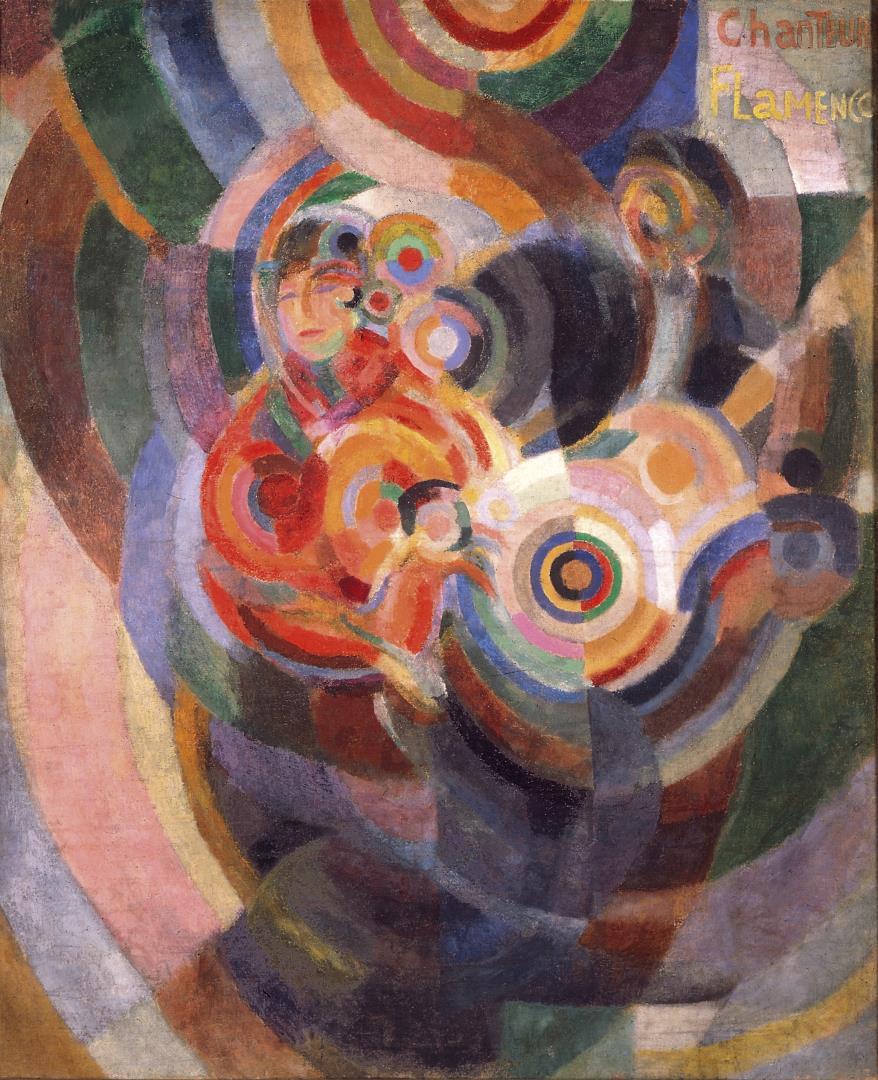
Evoking the performance-based musical theme of flamenco, this Grand Flamenco by Sonia Delaunay makes the orphic circles, characteristic of her painting, dance to the hot rhythm of the “Spanish night”. The canvas will have been painted in Portugal, in the house in Vila do Conde where Sonia and Robert Delaunay resided during the summer of 1915.* Two works on paper, from 1915 and 1916, follow the same composition, exploring the treatment of the theme in a crescendo of abstraction, and reveal the artist’s interest for the visual representation of the canto jondo.

Sonia had already worked the relationship of light-colour/movement through dance in Le Bal Bullier, Paris, 1913, a painting that caused scandal, «probably the first time that a pure movement was portrayed in art without, like the futurists, breaking up form in a series of repetitions like a film».** As she would write in her autobiography many years later, the continuous and undulating rhythm of the tango provoked its colours to move, «the Bal Bullier was for me what the Moulin Rouge de la Galette was for Degas, Renoir, Lautrec. The rhythms gave us the desire to make the colours dance».***

In Spain, where she lived in the year immediately following the start of World War I, the representation of the flamenco show was a natural progression from the register of the cadences of the tango and foxtrot of Bal Bullier. Sonia attempted a chromatic interpretation of flamenco, establishing an interesting analogy between the circular movements of its choreography, kept close to the dancer’s body, and the dynamic imparted to the circles, which she “makes dance”. The bodies of the two performers emerge from this powerful idea of movement, generated by the juxtaposition of coloured semicircles, in keeping with the technique of simultaneous contrasts.

The canvas, with several repaints by the artist during the 1950s, has come to acquire an iconic status in the long and diverse artist production of Sonia Delaunay, in particular for the period between 1914 and 1921, «les grandes vacances» as she liked to refer to her years spent on the Iberian Peninsula.

This euphemism was not just an elegant way of referring to the non-participation of Robert Delaunay in the Great War. For Sonia, these years were in fact a time of creative happiness, in which she let herself be seduced by themes and images of popular culture, in whose visual transcription she applied the simultaneist investigations that she had previously carried out in Paris, and in which she explored new materials. The relationship between art and life, fundamental for modern artists, found another expression, particularly successful, in her activities as a designer of textiles, objects, theatre and dance figurines, activities that she developed when her financial stability, from an allowance that she received from Russia, came to an end in March 1917. With these new supports, the colours and luminous shapes created by this painter, who claimed the ancestry of the sun, came to be known, with major impact and by a significant number of people.


Ana Vasconcelos
Maio de 2010


* With their son Charles and the painters Eduardo Viana and Sam Halpert.

** Viveca Bosson, «Sonia Delaunay», in Sonia Delaunay, Lund, Skissernas Museum, 2007, p. 139.

*** Sonia Delaunay, Nous irons jusqu’au soleil, Paris, Robert Laffont, 1978, p. 36.

Cookies settings

Cookies Selection

This website uses cookies to improve your browsing experience, security, and its website performance. We may also use cookies to share information on social media and to display messages and advertisements personalised to your interests, both on our website and in others.