Eduardo Batarda

Ao Exp. Abs. 1 [Baja California (Corte e Costura)]
Oct 1974

Gallery


Object details

Author(s)
Eduardo Batarda (Coimbra, Portugal, 1943 – Lisbon, Portugal, 2025)
Title
Ao Exp. Abs. 1 [Baja California (Corte e Costura)]
Translated title
To Abs. Exp. 1 [Baja California (Cut and Sew)]
Date
Oct 1974
Materials and media
Paper; Watercolour; Indian ink
Technique
Watercolour on paper; Indian ink on paper
Dimensions
Height 38,50 cm; Width 55,50 cm
Inventory no.
98DP1728

Inscriptions

Type
Signature
Description
Batarda
Position
Front, lower right corner
Type
Date
Description
74/10
Position
Front, lower right corner

Incorporation

Type
Purchased
Provenance
Eduardo Batarda (1943-2025)
Intermediary
CAMJAP/FCG
Date
February 1998

Text

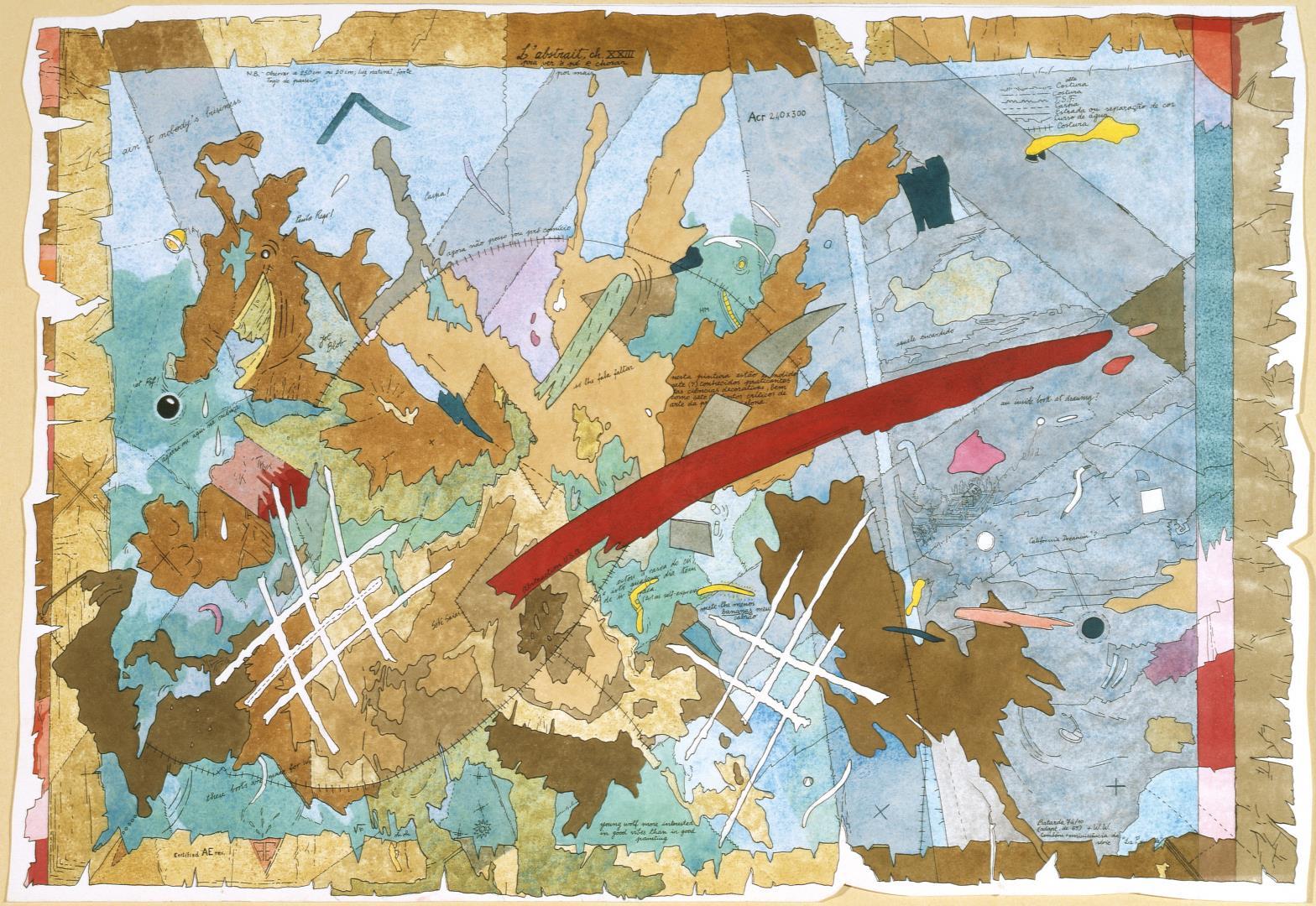
This painting is a good example of the refined technique – minutely detailed watercolour and drawing – which Batarda found to be the most apt vehicle for his critique of the state of the arts.  The various verbal inscriptions, operating at the level of painting, weave a web of complex meanings, an intricate filigree of allusions both erudite and popular, while also being clearly self referential. As in a strategic map, or one used to find ‘a treasure’ (art), with its allusions of an aged surface in the ragged cut-out edges, we find here an amalgamation of cartographic pseudo-signs, seamed together in a patchwork of anthropomorphic fragments, operating as a caricature of process painting or of the French group Supports/Surfaces. In its cumulative aspect, in the title, in the programmatic reproduction of webs and brush marks drawn from gestural painting, in some of the inscriptions, the work parodies Abstract Expressionism. Accompanying the artist’s signature is a written clue pointing to ‘La Peinture qui coule’, an inscription that the artist had used in some of his watercolours of 1971-1972. Meaning not only ‘painting that drips’ but also ‘painting that sinks’, the recurrence of this phrase points to the constant presence of a critique of art in general, as well as of his own work, and reminds us that this painting is a kind of revisitation, Batarda’s commentary on his own painting as art critique. 


MPS

May 2010

Cookies settings

Cookies Selection

This website uses cookies to improve your browsing experience, security, and its website performance. We may also use cookies to share information on social media and to display messages and advertisements personalised to your interests, both on our website and in others.