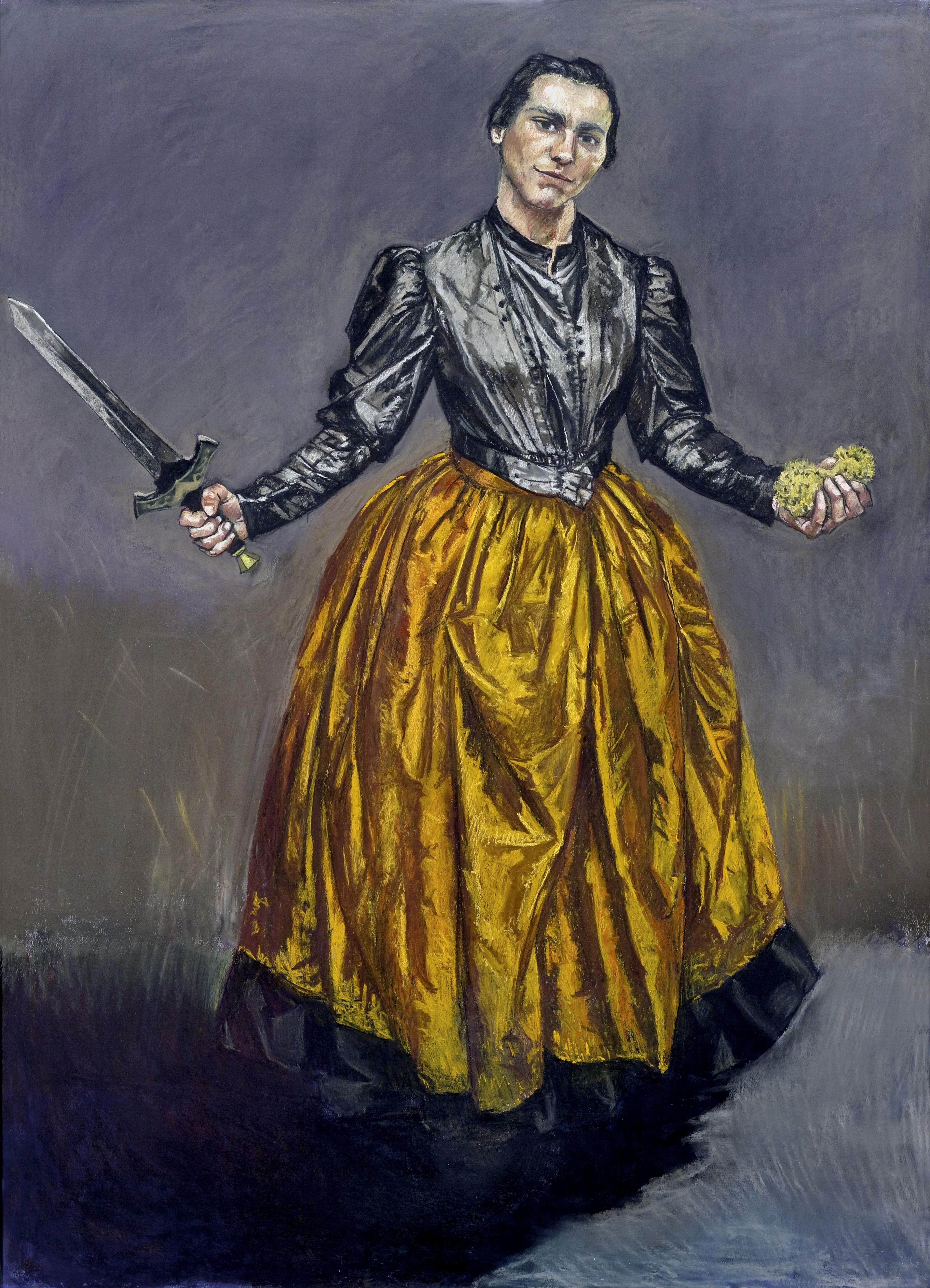
Paula Rego

Angel (from the series 'O crime do Padre Amaro')
1998
On view

Gallery


Object details

Author(s)
Paula Rego (Lisbon, Portugal, 1935 – London, United Kingdom, 2022)
Title
Angel (from the series 'O crime do Padre Amaro')
Date
1998
Materials and media
Paper; Aluminium; Pastel
Technique
Pastel on paper mounted on aluminum
Dimensions
Height 180,00 cm; Width 130,00 cm
Inventory no.
21P1960

Incorporation

Type
Purchased
Provenance
Ostrich Arts Ltd
Intermediary
Helena de Freitas
Date
December 2021

Text

‘Angel’ is one of Paula Rego’s most iconic works, manifesting a synthesis of all her artistic production – the artist even stated that this would be the painting she would take with her when she left. It shows the figure of a powerful woman, identifiable as an ‘Angel’, both avenging and merciful, clutching a sword and a sponge, symbols of the Passion of Christ or of his punishing force. Though not explicitly a self-portrait, it is a strong image that identifies with the interventionist sense of the artist’s work: between protection and revenge, punishment and forgiveness.
The painting is part of a series of works inspired by the Portuguese novel ‘The Crime of Father Amaro’, by Eça de Queirós, and is an example of the artist’s own fictional intervention on the story. The novel, forbidden reading at the time of its controversial publication in Portugal (1875), and which sparked protests from the Catholic Church for approaching questions such as clerical celibacy and the permitted death of illegitimate newborns, provided the artist with a wealth of fictional material.
Paula Rego establishes a non-illustrative dialogue with the novel, using all the visual resources of the pre-modern pictorial tradition to characterise her figures, exposing them in the fragility of their ethical and moral behaviours and developing a subversive reading. It is not just a condemnation of the acts, but also a cutting and painful revelation of the rituals of power, submission and complicity between sexes and classes. This is particularly evident with the figure of Amaro, the weak and sinful priest, ambiguous and malign, who is subject to a series of subtle deviations and shifts in time.


Helena de Freitas
Curator at CAM

Cookies settings

Cookies Selection

This website uses cookies to improve your browsing experience, security, and its website performance. We may also use cookies to share information on social media and to display messages and advertisements personalised to your interests, both on our website and in others.