
Gallery
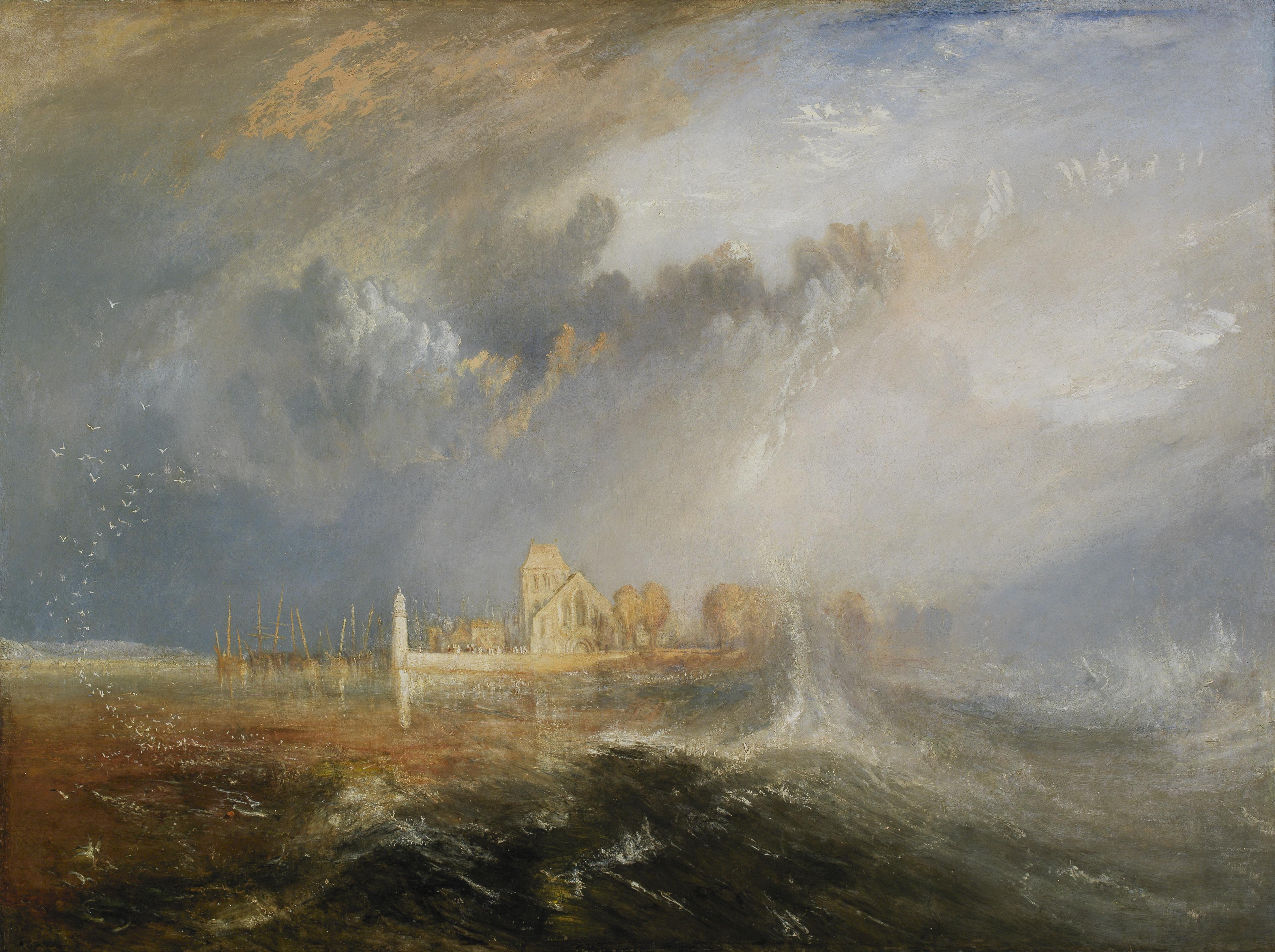
This canvas depicts the small village of Quillebeuf, on the Seine estuary, a place Turner visited during the 1820s. The painting encompasses a combination of important factors for understanding his working methodology, which includes naturalist observation, memory and the sensitive recreation of reality.
Based on these premises, the artist establishes a narrative that develops in three distinct moments, beginning with the flight of a flock of seagulls rising into the sky in a spiral, which is crucial to the disciplined balance of the composition, unfolding in an uninterrupted multiplicity of circles.
In a second moment Turner proceeds to the topographical documentation of the town, in which the tragic trilogy of ‘lighthouse, church and cemetery’ stands out, symbolic notes that add extra dramatic force to the composition. The scene culminates with the representation of a local phenomenon, called mascaret or barre, a huge wave that sinks ships, symbolised by the sinking vigil tower. An emotive exercise in light and colour, one can recognise in Turner’s work the tendency towards a progressive elimination of forms, dissolved into the humid atmosphere of the scene.
Object details
- Author(s)
- Joseph William Turner (London, United Kingdom, 1775 – London, United Kingdom, 1851)
- Title
- Quillebeuf, Mouth of the Seine
- Date
- 1833
- Technique
- Oil on canvas
- Materials and media
- Canvas; Oil
- Dimensions
- Height 88,00 cm; Width 120,00 cm
- Inventory no.
- 2362
Incorporation
- Type
- Purchased
- Place
- London
- Provenance
- Thomas Pitt Miller
- Intermediary
- Knoedler
- Date
- 26 Apr 1946